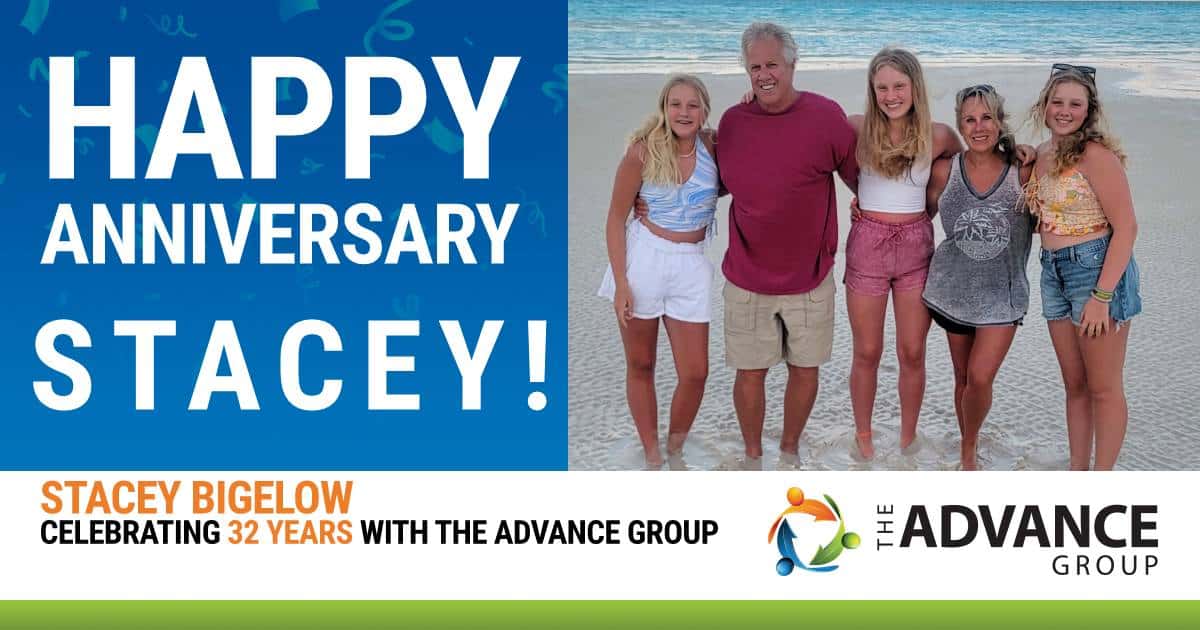
HAPPY 32ND ANNIVERSARY STACEY BIGELOW!

To celebrate Stacey Bigelow’s 32nd year with The Advance Group, we sat down with her for a Q & A session with the CEO. Here are a few highlights to enjoy:

Q: Favorite Junk Food?  

A: Chips and Salsa, the saltier the chips, the better ?

Q: What is the best concert you’ve ever been to? 

A: Bruno Mars, he was OUTSTANDING!!

Q: What is one non-work related goal that you would like to achieve in the next five years?

A: I would like to get scuba certified. I love the Caribbean and there are some fantastic places to explore in the water. I just need to overcome my fear of sharks ?

As mentioned above, Stacey is CEO here at The Advance Group. Happy Anniversary, Stacey!

Looking for a Flexible Schedule? Consider a Job as a Production Worker

When you’re looking for work schedules that fit into your life, many traditional positions fall short. Five-day workweeks aren’t convenient or possible for everyone. If you’re in that group, then you may assume your options for work are limited.

Fortunately, that isn’t the case. Many production jobs use alternative schedules, giving you some additional flexibility.

If you’re looking for a more flexible schedule, here’s why you should consider a job as a production worker.

Available Flexible Schedules as a Production Worker

Ultimately, the exact schedule options you’ll find as a production worker varies depending on the employer. However, specific arrangements aren’t uncommon, making these roles exceptional opportunities for those who can’t always work five days a week or that prefer longer weekends all year round.

For example, four-day workweeks are widely available to those working in production. With these, you can regularly get three-day weekends, giving you more time to handle personal responsibilities.

You might also find part-time opportunities. These allow you to manage a busier schedule with greater ease by ensuring you can find employment that aligns with the rest of your life.

Plus, overtime is often available. That allows you to bring in extra cash when you can head to work for an additional day. It’s a great way to boost your earning potential while still keeping a traditional two-day weekend intact.

Finally, production facilities often run multiple shifts. You may be able to choose a more traditional dayshift or explore 2nd and 3rd shift options. With non-dayshift roles, there may be a shift differential, allowing you to earn more per hour without dedicating extra time beyond your regular schedule and even more if you take on some overtime.

Finding Production Worker Jobs with Flexible Schedules

Many job seekers assume that finding production worker jobs with flexible schedules is challenging. Thankfully, if you partner with The Advance Group, you can explore several options with one application, including many that start right away.

Currently, The Advance Group is looking for production workers for a manufacturing facility in Maumee, OH. Along with two shifts, you work four days per week, giving you a three-day weekend. Plus, there are weekly attendance bonuses.

A Walbridge, OH, production facility is also looking for new employees. There are multiple schedules available, including ones that give you days off during the week and every other weekend off. You can essentially work full-time while getting seven out of every 14 days off, and overtime is also available.

If you have inspection experience, a Taylor, MI, automotive production facility is willing to offer flexible schedules to qualified candidates, or you can stick with the traditional dayshift option. For general laborers, a Canton, MI, company has part-time and full-time positions on both the 1st and 2nd shifts, allowing you to choose an option that works for you.

Reach Out to The Advance Group Today

If you’re looking for a flexible schedule and are interested in production work, The Advance Group wants to hear from you. Contact us today.

3 Simple Fixes for More Effective Job Postings

The effectiveness of your job postings has a significant impact on your recruitment efforts. By ensuring yours are in the best shape possible, you can access top talent faster, making it easier to connect with right-fit candidates and shortening your time-to-hire.

If you want to improve yours, here are three simple fixes for more effective job postings.

1. Get More Specific

In your job posting, you need to provide a clear picture of the nature of the role. Include a solid overview that discusses its function within the organization and use bullet points to highlight key responsibilities. Additionally, consider outlining a typical day in the job and balance that with a quick synopsis of some of the more exciting – but occasional – elements.

You can also include other details to add specificity. Discussing the function of the position’s team is beneficial, particularly if you can tie it into the company’s broader mission. You can also showcase how the organization makes a difference in the lives of its customers or stakeholders, as well as how it impacts its local community.

Additionally, make sure the job title itself is specific and accurate based on industry norms. While non-traditional job titles may make sense based on your culture, they won’t resonate with all candidates. Plus, they can lead to confusion, as figuring out what kind of role it is from the job title isn’t intuitive.

2. Use Keywords Strategically

When candidates search for opportunities, they rely on keywords. That’s another reason why the job title should reflect job seeker expectations, as those could be the phrases they’re using to find open positions that meet their needs.

It’s also wise to include keywords relating to required or preferred hard skills or technical capabilities. Stick to commonly used terminology over internal preferences. Your goal is to choose keywords that candidates will use as search terms, so any jargon or acronyms that aren’t widespread could cost you applicants.

Similarly, when describing soft skills or traits, go with typical phrasing. For example, “good communication skills” will get more hits than more creative descriptions like “wordsmith,” as candidates will search for the former far more often than the latter.

3. Include Accurate Salary Ranges

While companies are typically resistant to listing salary ranges for a variety of reasons, not knowing how much a job pays is a common pet peeve among job seekers. Candidates can’t determine whether they’d be open to accepting a role if they don’t have compensation details. As a result, they may apply, assuming that the position covers their needs, only to discover late in the hiring process that it isn’t a fit.

By including a salary range, you limit your talent pool based on the compensation you can genuinely offer. As a result, top contenders that advance through your hiring process are more likely to accept an offer (or negotiate to a mutually agreeable point) since they’re fully aware of your limitations.

Contact The Advance Group Today

Ultimately, all three of the simple fixes above can improve your job postings quickly and efficiently, allowing you to access the right kind of talent faster. If you’re working to fill open positions and need a quick, reliable solution that can provide you with high-quality candidates, The Advance Group wants to hear from you. Contact us today.

5 Things to Consider Other Than Compensation When Seeking a New Job

When professionals start looking for a new job, they often focus on compensation when reviewing opportunities. While pay rates are undeniably important, job satisfaction isn’t based on salaries alone. Instead, other factors play a surprisingly big role, so it’s critical to consider them when exploring your options.

Here’s a look at five things to consider other than compensation when seeking a new job.

1. Benefits

Outside of salaries, traditional benefits like medical insurance, dental coverage, vision insurance, prescription coverage, and retirement plans are commonly seen as essential. Make sure the jobs you’re exploring cover all of these bases. Additionally, look at the associated costs and employer contributions to these expenses, as not all programs are equal in that regard.

2. Company Culture

Having a company culture where you feel welcome and supported has a distinct impact on morale. Ultimately, you need to make sure you mesh with the physical environment and general mentality. It’s also crucial to choose a manager with a leadership style that aligns with your needs, as that can impact your success on the job and your broader experience.

Additionally, it’s wise to review the company’s mission and values. Ideally, you want to find an employer with a position that resonates with you, as a mismatch can decrease motivation, impacting your job satisfaction and performance.

3. Growth Potential

The ability to learn and grow on the job doesn’t just boost engagement; it can help you have a more satisfying and lucrative career. As you consider opportunities, look for information about company-provided training, mentorship programs, job shadowing, and educational perks like tuition reimbursement or student loan assistance. Additionally, find out if promoting from within is standard, as that’s often beneficial.

4. Sense of Purpose

Having a sense of purpose plays a substantial role in job satisfaction and morale. When you feel like your work matters, allowing you to contribute to an important mission, help your community, or otherwise have a meaningful impact, even tedious or challenging tasks are easier to shoulder.

This is a highly personal factor, as what provides one person with a sense of purpose may not work for another. You have to consider your priorities and preferences, as well as your values. That ensures you can find the best possible fit.

5. Work-Life Balance

When it comes to work-life balance, employers aren’t created equal. Companies that offer perks like flexible schedules, telecommuting, wellness programs, financial coaching, generous paid time off, and similar options often make it easier to stay on top of your personal and professional life.

Since work-life balance means different things to each professional, consider your needs and preferences in this arena. Then, you can factor them in when comparing employment opportunities.

Contact The Advance Group Today

Ultimately, while salaries are a critical part of the equation, other factors are also worth looking at when you’re seeking a new job. If you’d like to learn more or are interested in a new position, The Advance Group wants to hear from you. Contact us today.

The Importance of Ongoing Training for Employees

Ongoing training for employees is a crucial addition to your workforce management plan. When you offer skill-building opportunities to your workers, everyone stands to gain. As a result, any investment in training typically produces a solid ROI, all while increasing the odds that employees view your company as an employer of choice.

By understanding the importance of ongoing training for employees, you can capture the most benefits. Here’s what you need to know.

Improving Retention

Most professionals have career goals beyond their current position. Additionally, many top performers thrive on challenges. By offering ongoing training, you’re creating opportunities for your workers to grow and advance. Plus, it introduces engaging challenges that can boost morale.

Ongoing training also makes employees better at their jobs. New skills can boost productivity and efficiency, enhancing their work experience in a positive way.

In turn, these improvements can bolster retention. When job satisfaction rises, professionals are less inclined to look at other opportunities. Similarly, when growth and career progression come with it, they don’t have to explore options outside of the company to advance. Finally, if they can’t get the same training elsewhere, they’ll view your organization as an employer of choice, further improving retention.

Simplifying Recruitment

In a similar vein to the point above, ongoing training for employees can make recruitment easier. Once word spreads about your offerings – particularly if you establish your company as an employer of choice – attracting top talent is easier.

Job seekers commonly favor organizations that offer opportunities for growth, development, and advancement. Since ongoing training brings that to the table, your open jobs are inherently more enticing, leading to higher-quality applicants.

Closing Skill Gaps

When companies offer training, they have the ability to curate the program to meet their needs. As a result, it can be far more effective at closing skill gaps than having to find those capabilities solely through new hires.

During the planning phases, explore each team and department to determine if specific skill gaps are harming productivity or efficiency. Additionally, consider whether particular projects are on hold simply because the right skill set isn’t available. If so, you can strategically choose courses that address those needs, allowing you to cultivate an increasingly capable workforce while aligning their progression with the company’s interests.

Boosting Productivity

With ongoing training, companies have a range of opportunities to boost productivity. They can introduce courses that support the introduction of cutting-edge technologies that enhance efficiency, allowing employees to work more effectively. Additionally, as capabilities improve, so does worker confidence, making them feel better equipped to handle challenges or embrace change.

Ultimately, ongoing training for employees is a powerful tool, one that can boost retention, close skill gaps, and improve productivity. Plus, it can lead to morale and job satisfaction gains, all while positioning your company as an employer of choice.

Contact The Advance Group Today!

If you’d like to learn more about how you can cultivate a capable workforce or need to expand your team quickly, The Advance Group wants to hear from you. Contact us today.

3 Reasons to Consider a Job as a Machine Operator

Machine operators are skilled professionals who use specific equipment to handle responsibilities in an industrial, production, or manufacturing environment. Currently, demand for machine operators is high, creating ample opportunities for interested job seekers.

If you’re curious about whether becoming a machine operator is right for you, it’s helpful to understand what you have to gain.

Here is a look at three reasons to consider a job as a machine operator.

1. Working with Your Hands While Using Technology

In many ways, becoming a machine operator allows you to experience both the joy of working with your hands and the excitement of using cutting-edge technologies. It creates a degree of balance in that regard that you don’t get with many other positions, which can make it particularly rewarding.

Additionally, you get the benefit of seeing a physical representation of your effort in the products or components you help create. That can be incredibly beneficial for those who need to see the fruits of their labors, allowing you to remain motivated and engaged with greater ease.

2. The Chance to Learn a Wide Array of Equipment

While many machine operator positions focus primarily on a particular type of equipment, opportunities to explore new machinery are also commonplace. As a result, you can expand your skillset and have new experiences, keeping the work engaging while boosting your resume over time.

There are also new advances in the world of machine operation regularly. That means there are always new technologies to learn during your career. For those who crave challenges on the job or like to explore exciting developments, that can make these roles incredibly rewarding.

3. Your Work Stays at Work, Leading to Better Work-Life Balance

For anyone who wants better work-life balance and prefers to ensure their work stays at their workplace, a job as a machine operator could be a perfect fit. You’ll never be expected to take equipment home with you to finish a task. Instead, your work ends when you rap up your shift and head for the door, so it won’t intrude on your personal time.

Additionally, machine operators typically won’t get hit with after-hours work calls or emails. As a result, it’s possible to fully disconnect from your job when you’re home. Similarly, you won’t experience disruptions when you use vacation time to recharge. Couple that with the fact that most industrial, manufacturing, and production companies offer ample paid time off, and you may find that work-life balance is far easier to achieve when you’re working in a machine operator position than in many other careers.

Ultimately, a job as a machine operator can be an excellent opportunity for all of the reasons above. Plus, the salaries and benefits packages are competitive, and you’ll typically have chances to advance as you gain experience. In the end, that can lead to a solid career, all while maintaining better work-life balance.

Contact The Advance Group Today

If you’d like to learn more about machine operator opportunities, the team at The Advance Group wants to hear from you. Contact us today.

Interested in a Warehouse Position? Here’s 3 Reasons to Consider Becoming a Forklift Worker

Many job seekers are surprised by the variety of warehouse positions that are available. If you’re interested in the warehousing industry and are trying to pick a suitable role, becoming a forklift worker could be a great move. It offers long-term career potential, and that’s just one of the benefits.

A warehouse employment agency shares three reasons to consider becoming a forklift worker:

1. High Demand Leads to Competitive Salaries

First, it’s critical to note that forklift drivers are in demand. Nearly every warehouse needs employees in these roles. Plus, there are opportunities in production facilities, manufacturing plants, shipyards, logistics centers, and more.

There’s also a shortage of qualified forklift workers. Since that’s the case, demand is high while the supply of candidates is low. Along with leading to ample opportunities, this imbalance means that competitive salaries are typically easy to secure. Higher pay is classically how companies compete with one another to secure top talent, which can mean a long and lucrative career for you.

2. Launch a Career Without a Degree

While many careers require a significant amount of formal training or college degrees to get started, that isn’t the case with forklift driver positions. Companies are required to provide specific training to all of their forklift operators upon hire based on rules set forth by the Occupational Safety and Health Administration (OSHA) and similar state-based agencies. That training is mandatory regardless of the new hire’s previous experience or training.

While most of the training requirements focus on safety, companies often have more comprehensive training options available. Since there’s also a shortage of qualified forklift workers, employers are increasingly willing to train new hires even if they have no previous experience or training. As a result, you may qualify for the role as long as you have a high school diploma or its equivalent.

3. Acquire Numerous Transferable Skills

When it comes to skill development, accepting a forklift driver position won’t just give you a chance to hone your forklift operating skills. You’ll also gain a slew of other transferable skills that can apply to a wide range of roles.

For example, driving a forklift can improve situational, safety, and spatial awareness. These are valuable in any industrial environment, as the fast-paced nature of these workplaces makes spatial, situational, and safety awareness must-have capabilities.

Forklift driving can also introduce you to the broader world of equipment operation. While every piece of machinery is different, you’ll learn concepts that apply to other types of equipment. In some cases, you’ll also acquire troubleshooting and maintenance skills, though this varies from one employer to the next.

Finally, forklift driving teaches you attention to detail and problem-solving. You often have to memorize the locations of products or materials, ensuring you pull the right ones or deliver them to the correct area. Problem-solving factors in when you’re moving through complex environments, having to stack items safely, or taking on similar challenges.

Connect with a Warehouse Employment Agency in Toledo or Detroit to Find Forklift Jobs

Ultimately, becoming a forklift worker can be the foundation of an excellent career, giving you new capabilities that can keep you moving forward or help you transition into other roles. If you’d like to find a forklift job, The Advance Group has warehouse employment agencies in Toledo, Southgate, and Monroe that can help. Browse our warehouse jobs in Ohio and Michigan and apply today!

Preparing for 2023: Here’s What to Consider for Your Workforce Planning Strategy

During this time of year, many companies start looking ahead and preparing, ensuring their workforce planning strategy can help them excel in 2023. However, that may seem particularly tricky this time.

Unique situations arose during 2022, and certain economic factors are creating a degree of uncertainty for the year ahead. As a result, company leaders may need to adjust their approach.

If you’re preparing for 2023, here’s what you need to consider for your workforce planning strategy.

Updated Sourcing Strategies

Companies have been battling labor shortages for some time. Couple that with skill gaps and shifting employee sentiment in the aftermath of the Great Resignation, and many organizations are struggling to secure the talent they need to thrive.

As a result, your workforce planning strategy should include updated sourcing methods. Look beyond your career page and traditional job boards, as those alone may be insufficient. Instead, incorporate other techniques. Social media recruiting is particularly effective when you want to broaden your talent pool to include younger professionals, and it’s often cost-effective.

Working with a recruitment agency is another smart option. You’ll get expert guidance and support from professionals who focus solely on recruiting. Plus, staffing firms maintain deep talent pools filled with vetted active and passive candidates, giving you quick access to a wide range of skill sets.

Enhanced Workforce Agility

Inflation and a possible recession are impacting businesses in nearly every sector. As a result, your workforce planning strategy should include a degree of agility. The ability to scale up and down to meet demand or control costs can make weathering this kind of economic uncertainty easier, so it’s wise to include it.

By partnering with a recruitment agency that offers an array of hiring options – including temporary, temp-to-hire, and direct placement – you can choose the strategy that provides you with the needed degree of agility. Plus, temp and temp-to-hire options dramatically reduce risk while lowering costs.

Since the employee is initially on the recruitment firm’s payroll, companies aren’t shouldering the administrative burden associated with the new hire until they’re sure it’s a match. Further, unemployment and worker’s compensation are initially handled by the staffing agency, reducing your costs while controlling risk even more.

Improved Candidate Engagement

Candidate engagement is a critical factor in the workforce planning strategy equation. When job seekers are invested and supported, they’re more inclined to stick with the hiring process, accept an offer, and remain with the company long-term. As a result, finding ways to enhance the candidate experience is essential for companies in every industry.

Contact Our Expert Team Today

Finding a strategic partner that can boost candidate engagement is often wise. By working with The Advance Group, you can benefit from our reputation for treating job seekers right. Plus, we can improve various aspects of your hiring process, offering a streamlined experience and comprehensive onboarding that supports candidates and new hires every step of the way.

If you’re preparing for 2023 and want a strategic recruitment partner that can help you maintain agility and reduce costs while increasing your access to talent and boosting the candidate experience, The Advance Group wants to hear from you. Contact us today.

Want a Raise to Start the New Year? Here’s What You’ll Need to Do

For many professionals, starting the new year with a raise would be ideal. While some companies may automatically offer pay increases after conducting annual reviews, others may not. However, regardless of whether raises are common during the latter part of the year, it’s critical to set yourself up for success.

If you aren’t sure where to begin, here’s what you need to do if you want a pay bump to start the new year.

Review Your New Hire Paperwork

Whether you’re just starting in a position or have been with the same employer for years, your new hire paperwork may give you insights into the company’s raise structure. For some organizations, the salary increase process is well-defined and provided to every employee. As a result, it’s best to review this documentation to see if there are details you need to know.

Additionally, if you’re considering a new job, you can ask about raise structures when you receive your initial offer. That lets you know if the company has formal guidelines in place or if each request is examined on a case-by-case basis.

Consider Your Tenure and the Time Since Your Last Raise

In many cases, the longer your tenure, the better your position when asking for a raise. Many companies want to reward longevity and use pay increases to boost retention among employees whom they’ve grown to value and trust over the long term. If you’ve been with your employer for years, you’ll usually have a better chance of succeeding.

However, regardless of your tenure, you need to factor in how much time has passed since your last raise. While companies aren’t required to wait a minimum amount of time before adjusting an employee’s compensation again, the more recent a salary increase happened, the harder it may be to secure one for the start of the new year.

Figure out how long you’ve been with the company, as well as when your last raise occurred. If you’ve been with the organization for several years and your most recent increase was more than a year ago, then you’re likely in a good position.

Honestly Assess Your Performance

The quality of your performance is typically the biggest factor when it comes to getting a raise. If you’ve consistently exceeded expectations with all of your responsibilities, your chances are better than if you’ve fallen short, even in just one area. As a result, you need to honestly assess your performance based on the hiring manager’s expectations to ensure you’re work quality and productivity make a pay increase a justifiable request.

Additionally, consider your attitude at work. Even if you’ve exceeded expectations when it comes to your deliverables, a poor mentality or negativity may make you a poor candidate for a raise, particularly if it creates hardships for others. If you want a pay increase, make sure you maintain a positive attitude, even during challenging times.

Factor in Your Attendance

Finally, you need to consider your attendance. Frequent unexpected absences that were within your control or regular tardiness may make you ineligible for a raise even if you’re otherwise meeting or exceeding expectations.

Consider how many times you missed work or were late for questionable reasons during the past year, as more than one or two incidents may make waiting to request a raise a better option. Then, you can work to improve your attendance record over the next six months, increasing your odds of success down the road.

Contact The Advance Group Today

If you’d like to learn more about requesting a raise or would like to find a job with better compensation, The Advance Group wants to hear from you. Contact us today.

New Employees Ghosting You? 3 Ways The Advance Group Can Help You Retain Talent

Few things are as frustrating to employers as having new hires ghost after accepting a position. Along with the uncertainty ghosting creates, it often means going back to the drawing board and reigniting your hiring process, costing you time and money.

While ghosting is far more common than employers would hope, there are ways to combat it. By partnering with The Advance Group, you can find top-tier candidates that will have longer tenures at your company, providing you with exceptional value. Plus, you’ll get unprecedented support and guidance from recruitment and hiring experts, improving your results.

If you’re wondering how our team can help you reduce ghosting, here are three ways The Advance Group can benefit your company.

1. Access More Talent

At The Advance Group, we pride ourselves on maintaining a vast talent pool brimming with active and passive job seekers. Our recruitment efforts are always ongoing, allowing us to identify candidates with potential and connect with them to increase their availability to client companies.

Additionally, The Advance Group vets every job seeker, allowing us to assess their capabilities and mentality before recommending them for an opening. Candidate engagement is also a priority, ensuring job seekers remain invested throughout the hiring process.

Whether you need to fill entry-level positions or are seeking highly niche skillsets for hard-to-fill roles, our recruitment team can simplify the process. Along the way, we aim to make the experience simple for candidates, leading to a positive experience that ultimately boosts the reputations of our client companies.

2. Improve Onboarding

Onboarding is the foundation for success when companies bring in new hires. At The Advance Group, we understand how critical these initial experiences are, striving to make the best possible impression for our clients.

With the comprehensive onboarding process offered by The Advance Group, candidate engagement rises. Plus, since new hires feel prepared for the journey ahead and fully supported, a sense of loyalty often starts to build. In turn, ghosting is far less likely, reducing the need for client companies to relaunch their hiring process after finding a candidate that fits their needs.

3. The Culture Factor

The team at The Advance Group understands how a company’s culture impacts hiring, retention, and results. Our staff aims to maintain a positive culture that’s both candidate and client-centric, ensuring everyone we assist has their needs met.

Additionally, when placing candidates, we don’t just focus on their skills and experience. Instead, we ensure that culture fit is part of the equation. Our recruiters spend time getting to know our client company’s cultures and the unique personalities and preferences of job seekers. As a result, we’re better equipped to find right-fit candidates that will thrive in your environment quickly.

Contact The Advance Group Today

Ultimately, partnering with The Advance Group leads to a better candidate experience, all while shortening hiring timelines and giving clients access to high-quality job seekers that truly meet their needs. If you’d like to experience the difference firsthand, The Advance Group wants to hear from you. Contact us today.

3 Guaranteed Ways to Improve Time to Hire

When companies need to fill vacancies, speeding up time-to-hire is often a priority. Being shorthanded is burdensome, leading to larger workloads for other employees, which can potentially increase stress levels, harm productivity, and limit worker access to leave. When it carries on for an extended period, burnout and turnover are more likely.

Additionally, an extended time-to-hire negatively impacts candidate engagement. While most job seekers acknowledge that hiring processes take time, longer-than-average delays harm the candidate experience. At times, it damages recruitment to the point where ghosting or similar issues become burdensome for employers.

Fortunately, improving time-to-hire isn’t inherently challenging. Here are three guaranteed ways to shorten your timeline.

1. Use the Right Sourcing Strategy

Not all candidates turn to the same resources when looking for opportunities. If you’re limiting your job ads to large job boards and company career pages, the limited number of sources and the declining popularity of some of the traditional options in these categories mean missing out on talent.

Instead, diversify your sourcing strategy. Identify the sites and platforms your ideal candidates frequent, including social media, niche message boards, networking organizations, college employment offices, and similar resources.

Additionally, partner with a staffing firm to broaden your reach. Professional recruiters know how to meet candidates where they are due to their expertise, making them an asset when you need to secure specific skills quickly.

2. Present a Compelling Employer Value Proposition

When you create job ads, view them from the perspective of candidates. Consider what they’d want to know about the role, particularly when it comes to the aspects that benefit them.

For example, listing salary ranges lets you connect with job seekers who are willing to take on the duties for the stated pay. Including details about benefits, perks, training programs, diversity and inclusion initiatives, and your company culture lets them see how the organization supports its workforce.

Essentially, presenting a compelling employer value proposition helps candidates see what’s in it for them. In turn, you’ll typically receive more qualified applicants in a shorter period.

3. Streamline Your Application and Screening

Lengthy and cumbersome applications and screening steps harm the candidate experience. When an application is overly complex to time-consuming, many job seekers will abandon the process. Along with missing out on talent, this could extend your time-to-hire timeline due to a lack of quality candidates.

Similarly, when screening steps take too long, they inherently lengthen the timeline. Couple that with the risk of declining candidate engagement causing job seekers to drop out of the process, and your time-to-hire suffers.

Make sure to streamline your application and screening as much as possible. Limit applications to include only the essentials. Requesting a resume or application (not both), eliminating essay questions, reducing the skills proficiency questions, and scaling back on similar steps give you more candidates to consider as the odds of completion go up.

Similarly, handling screening steps simultaneously instead of in succession shortens the timeline, so consider conducting background checks (if they aren’t instantaneous) while also reviewing references. You can also hold panel interviews instead of one-on-one meetings if multiple managers need to be involved in the decision.

Staffing firms can also assist with streamlining your hiring process. Along with simplified recruitment processes, recruiters can screen for specific skills, meet with candidates to assess culture fit, conduct background checks, and handle other steps on your behalf, making the experience faster for all involved.

Contact the Advance Group Today

If you’d like to see how a recruitment agency can reduce your time-to-hire, The Advance Group wants to hear from you. Contact us today.


How to Determine a Company’s Culture When Job Hunting

Most candidates view company cultures as priorities when seeking out new opportunities. When the fit is right, a strong culture helps employees excel. Plus, a positive company culture can enhance engagement, boost morale, and improve productivity, leading to higher job satisfaction.

In many cases, gauging a company’s culture when job hunting is tricky, particularly if you don’t turn to the right resources.

If you want to make sure you can determine a company’s culture during your job search, here are some helpful tips.

Do Your Research

When you need to assess a company’s culture, begin by doing some online research. Check out the company’s career pages, job ads, and social media profiles for insights. You can also read reviews on websites that allow current and former employees to offer their opinions.

If you have the team manager’s name, consider checking out their public social media profiles. This might provide insights about their expertise, management style, views on innovation, and more, making it a valuable way to gather information.

Broaden your research by tapping into your network, too. Speak with current or former employees, as well as others in the field or industry who may have insights to offer.

Ask Questions During Interviews

Candidates usually get an opportunity to ask the hiring manager questions at the end of an interview, so use this time to learn about the company’s culture. Ask the hiring manager to describe the culture, as well as their leadership style and the current team dynamic. Finding out what the hiring manager likes most and least about working there is often enlightening, as well as how the company differentiates itself from competitors. Asking about the key traits that will help someone succeed in the role also helps, as it shows you details about the hiring manager’s priorities and the type of person that is likely to excel in the job.

Be Observant When On-Site

Being observant when you’re on-site can give you clues about the company’s culture. As you enter the building for an interview, gauge the mood of the employees you pass and get a feel for the workplace.

Examine the environment and work areas, and listen to the tone of anyone speaking. See how much workstation personalization is present, as well as assess the lighting, temperature, color palette, and other environmental factors. Often, these points reveal a lot about a company’s priorities, values, and vibe, which helps you determine the overall culture.

Partner with The Advance Group for Your Job Search

When you’re looking for a company with an exceptional culture, partnering with The Advance Group can get you on the right track. At The Advance Group, culture fit is a priority. Additionally, our team factors in culture when choosing client companies to work with, ensuring candidates gain access to employers that exceed expectations when it comes to support, growth, communication, and more.

Contact The Advance Group Today

If you’re seeking out new opportunities and want to work for a company with a top-quality culture, The Advance Group wants to hear from you. Contact us today.

Ways to Determine a Company's Culture When Job Hunting The Advance Group