Three Things Every Successful Career Has in Common

While career success can take many forms, those who achieve it usually have a few things in common. By understanding why certain professionals excel while others struggle, you can use the right approaches. Then, you’ll be able to reach your ideal point easier, all thanks to the experience of others.

If you’re wondering what every successful career has in common, here are three things they typically share.

1. Networking Is a Priority

While your skills play a big role in career success, the connections you make and maintain also matter. By forging relationships with the right people, you can learn about unadvertised opportunities, secure coveted referrals, and get guidance at key moments in your professional life.

Thankfully, making networking a priority doesn’t mean it has to take over your life. Instead, it’s about spending a small amount of time on related tasks regularly. That can include designating 20 minutes a day to online conversations, speaking with colleagues for five minutes when you cross paths in break rooms, attending an event every quarter, and similar activities that help you cultivate a robust network.

2. Make the Most of Feedback

Feedback can be a powerful career booster when you fully embrace it. While it is hard to hear about shortcomings, that information creates opportunities for you to reach new heights. Not only can you improve your reputation with your current employer, but you can cultivate skills and expertise that make you a more attractive candidate when it’s time for a job change.

If you want to make the most of feedback, approach it with the right mindset. Usually, the criticism isn’t meant to target you as a person; it’s solely about performance. When you receive feedback, see it as a chance to learn more about how you can improve. Ask clarifying questions, request insights on how you can do better, and create a formal plan to head in the right direction.

By using that approach, you develop clear goals for growth. Plus, you can typically get support from your manager, giving you access to ongoing coaching that can help you thrive.

3. Seize the Right Opportunities

Over the course of your career, some unexpected opportunities usually arise. This can include anything from a chance to cross-train into a new area to an unanticipated position coming available that would require a shift in direction.

When you see an opportunity, take a moment to consider its potential. Envision how your career may play out if you say “yes,” including the potential risks and rewards.

For risks, do make sure you’re realistic. Your worst fear may not be particularly likely or, even if it does happen, the fallout may be far more manageable than it looks on the surface.

For rewards, think about other opportunities that may arise if you seize this one. Also, see how the change may allow you to achieve success in a way you didn’t initially consider.

By using that approach, you can figure out if moving forward is the right move. It lets you capitalize on chance without being too haphazard with your career, ensuring you can head in the best direction for you.

Ultimately, those who achieve career success usually follow the three tips above. If you’d like to learn more, the staff at The Advance Group can help. Contact us today.




Your Workforce Is Overwhelmed. What Should You Do?

Many professionals are overwhelmed with their workloads. They are simply being asked to do more than they can reasonably manage, leaving them frustrated, exhausted, and disengaged.

When this happens, there are things managers can do to improve the situation. If you’re wondering how you can help, here’s what you need to know.

Talk About Workloads

Many managers only have a basic idea of what each team member is handling instead of a full grasp on the size of their workloads. This lack of information can be detrimental, causing managers to incorrectly estimate how much more a worker can reasonably take on before experiencing a difficulty.

Ideally, managers should work to understand precisely what is on each team member’s plate. By scheduling meetings with each employee and openly discussing their workload, you can gather critical insights. It lets you know which workers may have room to take on more and which ones don’t, ensuring you don’t overload an employee accidentally.

Plus, you can get a chance to rebalance. If one team member is overwhelmed while another has space for additional responsibilities, you can switch tasks to create better equity.

Identify Work Priorities

By outlining which duties are genuinely high priority, your team knows where they need to focus their efforts. Additionally, they’ll know what tasks can actually wait, giving them some breathing room if it’s needed.

When you identify work priorities, keep the list short. You can’t put all tasks in that category. If you do, you make a challenging situation harder. So, be honest about what has to be handled sooner and where there is some leeway.

Encourage Time Off

Taking a break can work wonders. However, when workloads are heavy, many employees fear they’ll be looked down upon if they request days off. As a result, they push far longer than they should, increasing the rate of burnout.

Make sure you encourage your employees to use any paid time off they accrue. Let them know that breaks are important and that you support their decision. Then, make sure there isn’t any form of penalty for being away, guaranteeing that they don’t return to a harder situation than the one they left.

Eliminate Unnecessary Meetings

While meetings are sometimes essential, not all gatherings are necessary. When you schedule one anyway, you disrupt your team’s focus. They have to walk away from the task at hand, making it harder to establish a flow. Then, if their presence wasn’t genuinely necessary, time is wasted that could have been spent elsewhere.

When you plan a meeting, consider whether one is actually required. If another option is a better fit, use it instead. If not, keep the attendees list short, ensuring only those who actually have to participate are invited.

Let Employees Say “No”

Many employees are afraid to say “no” if they are asked to take on more work. As a result, their responsibilities keep growing, potentially reaching a size that’s more than they can handle.

Let your employees know that declining a new responsibility is okay if their reason is justifiable. Also, make it clear that being overwhelmed is a legitimate reason to say “no,” empowering them to announce if they have hit their limit.

Augment Your Workforce

When you’re shorthanded, it’s almost guaranteed that your workforce will get overwhelmed. By expanding your team – either permanently or temporarily – you get more hands on deck. When that happens, you can divvy out responsibilities in a more manageable way, giving everyone the space they need to remain productive, engaged, and happy.

If your team is overwhelmed and you want to bring in new employees to relieve their burden, the staff at The Advance Group can help. Contact us today.


Preventive Care – It’s Time to Get Back on Track

Has the Pandemic Paused Your Focus on Preventive Care?

The U.S. Centers for Disease Control and Prevention (CDC) has made plenty of recommendations and offered guidance regarding COVID over the past year. Did you know that they also track statistics related to preventive care? According to the CDC, 7 out of 10 Americans will die each year from chronic diseases (https://chronicdata.cdc.gov/), many of which are preventable.

Preventive care is used to detect illnesses and diseases early. This can help you avoid or better control your health problems by catching them early. Preventive care is all about maintaining wellness and good health. We all want that, don’t we? Your primary care physician (PCP) will perform services, such as a physical exam, screenings, laboratory tests and immunizations. But your wellness initiatives should not stop there. A healthy lifestyle also includes exercise, diet and sleep quality.

What Can You Do to Get Started?

  • Contact your PCP to get that annual physical and blood work completed.
  • While you are scheduling appointments, contact your dentist for a cleaning and your vision provider for an eye exam. Sometimes, these providers can detect underlying health concerns.
  • Incorporate exercise into your daily schedule. Start with a 30-minute walk. Getting outside will improve your emotional wellness in addition to physical wellness.
  • Pay attention to what you eat. Make sure that you are getting enough fruit and vegetables daily. Avoid eating too close to bedtime.
  • Get a good night’s rest. Be cautious of blue light exposure. (https://www.webmd.com/eye-health/blue-light-health)

Most health plans must cover a set of preventive services at no cost to you. Lists are available for adults, women and children (https://www.healthcare.gov/coverage/preventive-care-benefits/).

What are you waiting for? Take steps today to improve your overall wellness and get those preventive care visits.


Clean Up Your Work Environment (Watch Out for These Signs of Toxicity!)

A toxic work environment is detrimental to a company’s success. When toxicity reigns, morale falls, productivity tumbles, and turnover skyrockets. That uncertainty can worsen the situation, causing long-term damage that can harm a company’s reputation, both as an employer and as a goods or service provider.

Addressing toxicity in the workplace is essential. However, to do so effectively, you need to know when a problem is brewing. By looking out for certain red flags, you can nip issues in the bud before they lead to a toxic environment. If you aren’t sure where to begin, here are some signs of a toxic workplace on the rise.

Underperformers Aren’t Addressed

If your management team isn’t addressing underperformers, your company could be well on its way to becoming toxic. When employees fail to meet expectations consistently, they don’t just hinder their own performance; they can negatively impact an entire team. Others may have to make up for the underperformer’s shortcomings, causing them to become overburdened. Resentment also builds, damaging morale.

In some cases, not addressing underperformers gives other employees the impression that performance doesn’t matter. There’s little incentive to perform, as those who aren’t are not being addressed. In turn, productivity can start to fall across the entire team.

Ideally, you want to make sure that subpar performances are handled immediately. That way, coaching, training, and other approaches can be used to get the underperformer back on target quickly.

A “Do More with Less” Mindset

While resource management is essential for any business, the environment can quickly turn toxic if your company begins to adopt a “do more with less” mindset. Employees need the right tools to do their job effectively. If they are being denied access to critical resources but are being told to enhance their performance, frustration will build quickly. Many will believe that they’re being set up to fail, which can cause serious morale declines and increases in turnover.

Make sure that any cost-cutting measures don’t involve removing crucial resources. IF a change is going to make the employee’s job harder, it may not be a wise change.

No Clear Promotion Criteria

How promotion decisions are made can be a sign of a toxic environment. If there aren’t any clear criteria for advancing, that gives managers enough room to play favorites, which can be detrimental to morale.

If any promotions – or a lack thereof – seem unfair, negatively impacted employees may begin to doubt whether their efforts matter. Once they start feeling undervalued, a variety of poor outcomes can occur. Some may stop trying, causing performance declines. Others may start taking action to get noticed, some of which may involve harming other employees in an attempt to get ahead.

Suppose you want to avoid that situation, set firm, formal promotion criteria. This ensures all employees know exactly what it takes to move up, adding a degree of transparency to the equation.

Then, make sure your managers follow the criteria. That way, they can’t play favorites, intentionally or incidentally.

Ultimately, all of the issues could be signs of a toxic work environment. Using the tips above, you can help avoid those situations, ensuring your culture stays strong and positive.

If you’d like to learn more, The Advance Group staff want to hear from you. Contact us today.


Find a New Temporary Job Before Holiday Season!

Many people want to find a temporary job to make the holidays more affordable. Others take advantage of the time of year, using it to find short-term positions that meet their needs better than full-time, permanent roles.

In either case, if you want to find a new temporary job, you don’t want to wait to launch your job search. Instead, it would be best if you began right now. If you’re wondering why you should start right away, here’s what you need to know.

Hiring Processes Take Time

One of the biggest reasons to launch your job search is simply because hiring processes to take time. After you apply, the hiring manager has to spend a moment reviewing it. Next, they have to reach out and schedule an interview. Then, the hiring manager needs to conduct the interview, handle additional screening, and decide whether to extend an offer.

Once an offer is extended, the process still isn’t complete. There’s paperwork, onboarding planning, and integrating the new hire into the schedule to contend with, all of which can add some time to the equation.

In some cases, that process can take around 23 days. But that doesn’t account for any time you spend tracking down a suitable job opportunity. Plus, that’s just for one position. If you don’t land the first one you apply for, the total time can be longer.

You’re giving yourself time to move through the hiring process by starting your temporary job search now. Since hiring processes can be lengthy, this approach ensures you can start working by the holiday season.

The Best Temporary Jobs Fill Fast

Many companies start hiring their temporary, seasonal workers well before the start of the holiday season. Often, this is because it simplifies ramp-up planning on their end, ensuring they are fully staffed and able to deal with rising demand.

Since companies often plan for their seasonal hires, the best temporary jobs are usually available before the holiday. Savvy job seekers know that, so they start their job searches early, making it easier to snag the best-paying positions at employers of choice.

If you want access to the best selection of temporary jobs this holiday season, you want to start your job search now. That way, preferred positions will still be available, increasing the odds that you’ll be able to get your perfect role this year.

How to Find a New Temporary Job Before the Holiday Season

Finding a temporary job before this holiday season begins doesn’t have to be a challenge. By partnering with The Advance Group, you get access to skilled recruiters who can help you find your ideal position quickly, ensuring you’ll have exactly what you need to make this holiday season a bright one.

If you want to secure a temporary job for the holiday season, the team at The Advance Group wants to hear from you. Contact us today.


Happy 5th Anniversary, Niki Schroeder!


To celebrate Niki Schroeder’s 5th year with The Advance Group, we sat down with her for a Q & A session.  Here are a few highlights to enjoy:


Q: What is the best advice you’ve been given?
A: If it won’t matter in 5 years, don’t spend more than 5 minutes worrying about it.

Q: What charity do you support?
A: Acoustics for Autism. This is a great organization that provides scholarships to local families in need of funding for various therapies for their children with autism.

Q: What quote do you live by?
A: And though she be but little, she is fierce.


Niki is in Client Services and works in our Sylvania branch.  Happy Anniversary, Niki!

Happy 9th Anniversary, Mindy VanAcker!


To celebrate Mindy VanAcker’s 9th year with The Advance Group, we sat down with her for a Q & A session. Here are a few highlights to enjoy:


Q: What should everyone try at least once in their life?

A: Dancing in the rain!

Q: What quote do you live by?

A: “The Secret, is to surround yourself with people who make your heart smile. Its then, only then that you’ll find Wonderland”

Q: What’s your favorite song?

A: Eagles – Hotel California


Mindy is a Michigan Branch Manager and works in our Southgate and Monroe branches.  Happy Anniversary, Mindy!

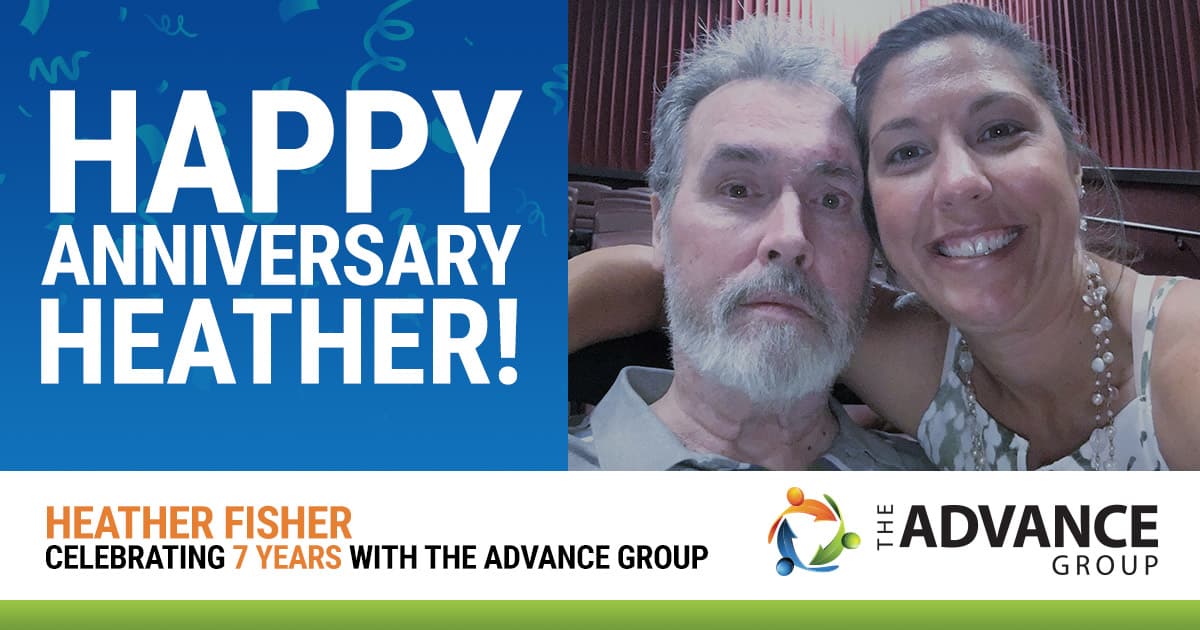
Happy 7th Anniversary, Heather Fisher!


To celebrate Heather Fisher’s 7th year with The Advance Group, we sat down with her for a Q & A session.  Here are a few highlights to enjoy:


Q: What is the best advice you’ve been given?

A: My dad taught me that every person in the world is unique and has something special to offer. It’s my choice as to whether I take the time to discover that in people or miss out. When I was younger, I used to tease my dad that he would talk to anyone. Now, my husband says that same thing about me. Some of my best conversations have been with complete strangers. I have gained some great wisdom through the years. This picture is the last one that I took with my dad. It is a constant reminder to keep being me and looking for the good in others.


Q: What brings you the greatest satisfaction?

A: Checking items off of a task/to do list. If I complete a task that wasn’t on the list, I write it down just so I can check it off.


Q: What do you like to do in your spare time?

A: Go hiking with my husband, Jeff, and our 2 dogs, Thane and Beatrice. It always relaxes me and provides time to connect.


Heather is a Human Resources Coordinator and works in Corporate.  Happy Anniversary, Heather!

Going Forward Every Manager Will Need These 3 Skills

While vaccine rollouts have been ongoing and re-opening processes are well underway, uncertainty remains. Many employees are dealing with a range of fears that weren’t common in the pre-pandemic landscape. Additionally, work paradigms have changed significantly, and many will remain altered for quite some time.

If a manager is going to navigate this new world successfully, certain capabilities are crucial. If you wonder which ones matter most, here is a look at three skills every manager will need going forward.

1. Empathy

Many professionals still have concerns about their health and wellness. Additionally, a significant number struggle to balance their personal and professional obligations, especially in response to ever-changing pandemic requirements and best practices.

Since struggle and worry are part of the landscape, leaders need to practice empathy. This can include during the development of formal policies and procedures and when interacting with an employee one-on-one.

The goal should be to be supportive and understanding, ensuring employee wellness remains a priority. By keeping that in mind, leaders can act in a more empathetic manner.

2. Hybrid Team Leadership

While many companies are bringing employees back into the workplace, the majority are doing it in stages, with a portion of their workforces working remotely on any given day. Some have decided to make telecommuting a permanent option for employees. In contrast, others have taken the extra step, openly recruiting distributed teams featuring professionals from around the country or world.

Since having remote team members will be a norm moving forward, managers need to adapt to that reality. Having hybrid team leadership skills is essential, ensuring you can effectively guide employees regardless of whether you ever engage in person.

Additionally, managers will need the ability to promote collaboration in these distributed environments. That’s another component of a comprehensive hybrid team leadership skill set. Effective collaboration ensures productivity remains high, making it critical for overall success.

3. Diplomatic Decision-Making

In most cases, managers are responsible for making a wide variety of decisions while performing their duties. However, doing so in isolation isn’t ideal.

Instead, leaders need to embrace diplomatic decision-making. This includes learning about the needs, respecting outside opinions, and delivering decisions in a manner that doesn’t lead to significant negative emotions.

Effective diplomatic decision-making often begins with feedback. Learning about their needs and preferences with employees ensures leaders understand how their teams view a situation. From there, they can more easily identify mutually beneficial paths, ensuring that both the company’s and team’s needs are adequately addressed, and any hardships are limited.

Ultimately, all three of the skills above will be crucial for managers today and well into the future. By developing them now, leaders can ensure that they are ready for the post-pandemic business world.

If you’d like to learn more, the staff at The Advance Group wants to hear from you. Contact us to speak with a member of our knowledgeable team today.


How to Become Easy to Hire

When companies hire a new employee, they are effectively taking a risk. While they know that adding a member to their team is crucial, they also understand that a bad hire can be incredibly costly. Since most hiring managers are working with minimal information, choosing the right candidate is often difficult.

However, candidates can position themselves as the obvious choice for a role by using the right approach. If you want to become easy to hire, here’s what you need to do.

Emphasize the Right Skills

During the hiring process, you need to make sure that you put the right skills on display. When you’re crafting your resume or practicing interview answers, use the job description as a guide. Review the must-have skills list to determine the hiring manager’s main needs. Then, make sure to address those capabilities specifically in your application and when you respond to interview questions.

As you do, make sure that you touch on both hard skills and soft skills. Many modern employers understand that each plays a critical role in a new hire’s success, so it’s worth addressing them both along the way.

Demonstrate Culture Fit

Today, hiring managers aren’t just looking for candidates with the right technical skills; they also want to find job seekers who will mesh with its culture. As a result, you need to demonstrate that you’re a strong culture fit, making it clear that you’d thrive in the environment.

Typically, the simplest way to do this is to review the company’s website for critical information. When you head to the site, check the About Us page and read the company’s mission and values statements. Often, these provide you with insights regarding the company’s priorities and mindset.

Additionally, review the company’s social media pages. There, you can find out more about its outward personality, something else that can help you learn more about the company’s culture.

After finishing up your research, incorporate points that demonstrate you’d integrate well. In some cases, you can reference the mission or values statements directly into interview answers. In others, you’ll simply want to create a sense of alignment.

Showcase Company Knowledge

If you want to stand out from the competition, showcasing a bit of company knowledge during your interview can make a difference. When you practice your interview answers, seize opportunities to reference company products or services specifically, allowing you to demonstrate that you took the time to learn about their offerings.

You can also discuss recent company achievements or news events. Again, these showcase that you went the extra mile to learn about the organization.

Highlight a Differentiator

When you create your resume or head into the interview, you want to highlight points that differentiate you from the pack. This could be an unconventional skill in your professional background that makes you particularly well equipped to handle a challenging part of the role or an experience that gives you a unique perspective that could benefit the company.

By using the tips above, you can become easy to hire. If you’d like to learn more about what it takes to succeed during your job search, the team at The Advance Group wants to hear from you. Contact us today.


Part-Time Jobs: How This Flexible Option Could Work for You

When many candidates launch job searches, they focus on full-time positions. In some cases, this is intentional. However, in many situations, it’s simply a default. Overlooking part-time roles isn’t based on a genuine need for full-time work. Instead, it’s due to an assumption that it’s the better option.

In reality, part-time jobs can be a better fit for many professionals. If you’re wondering if a part-time position might be right for you, here’s what you need to know.

Get More Flexibility with a Part-Time Job

Generally speaking, a position is considered part-time if the employee works less than 30 hours per week. For some professionals, that kind of reduced schedule is preferred. It gives them more time to handle personal obligations, making work-life balance easier to achieve.

Depending on the job, you may work shorter shifts each day or fewer days every week. Both approaches can have merit, so consider which best meets your needs as you seek out opportunities.

It is important to understand that there isn’t an official number of hours separating part-time from full-time jobs. As a result, while less than 30 hours is the norm, companies may view the cutoff differently.

Benefits May Be Available

While comprehensive benefits packages are commonly associated with full-time positions, that doesn’t mean that you can’t get any benefits if you work part-time. While what’s offered varies by employer, some companies provide their part-time staff with access to healthcare coverage, paid time off, retirement options, and other perks.

If benefits are necessary, you can focus your part-time job search on companies that make them available. That way, you can get access to the ones you need without having to work a full-time schedule.

Career-Launching Opportunities

At times, a part-time position can be the ideal way to launch a career or shift into a new field. You’ll get a chance to build relevant skills that can help you head in a new direction, as well as have a reference you can list when you begin your next job search.

In some cases, companies are more flexible about skill requirements when they hire part-time employees. As a result, you may have an easier time securing a position in your new field, allowing you to get your career moving forward faster.

Work Your Way into a Full-Time Position

In some cases, a part-time job can open doors that lead to full-time positions. When you exceed expectations in a part-time role, your employer could realize your potential. In turn, this can make you the obvious choice for a full-time opportunity, causing them to offer you a chance to transition into the role.

Ultimately, a part-time job could be an ideal fit for many candidates. The arrangement offers more flexibility, as well as plenty of other benefits.

If you’re interested in finding a new part- or full-time position, the team at The Advance Group wants to hear from you. Contact us to speak with one of our recruiters today.


These Perks Can Help You Attract New Talent

As re-opening processes continue, many workplaces are welcoming employees back into the office. However, many professionals are concerned about the transition, particularly how it will affect health, wellness, and work-life balance.

If you’re trying to attract new talent, addressing these concerns through a series of office perks can help. Here are some additions that can make your workplace more enticing and inviting in the eyes of candidates.

Relaxation Spaces

Having rooms set aside specifically for quiet relaxation can be an ideal perk in post-COVID-19 workplaces. It gives your employees an area where they can step away and recenter, something that can make a difference as professionals reacclimate to traditional work environments and direct interactions with colleagues.

Private Workstations

Maintaining social distancing standards can be challenging in many workplaces. By providing your employees with private workstations, you can make it easier. It gives workers designated places to be, and workstations can be positioned to provide the required distance.

Adding some walls or dividers can also be beneficial. They may help prevent the spread of the virus should someone fall ill. If you use opaque walls, you can add an extra sense of privacy. If you go with transparent materials, you can maintain an open feel while supporting separation.

Social Areas

Designating specific spaces as social areas can be a wise move. You create spots where socializing isn’t just permitted but actively welcomed. This can boost bonding among team members, something that may need a boost as they return to the workplace. Plus, these spaces can inject some fun into the work equation.

Within the social areas, add some opportunities for recreation. Mini pool tables, puzzles, or game consoles could be nice additions, particularly if team members are encouraged to interact with one another while participating.

Vibrant Interiors

In years past, many workplace interiors were far from inspiring. Furniture, flooring, and wall paint tended to be incredibly neutral, creating bland spaces that lacked energy.

If you want to attract new talent, updating your interior to be more vibrant can be a smart move. This can include adding bright pops of color, incorporating plants, displaying art, or other options that make the spaces feel lively.

Free PPE

While re-opening procedures are well underway in many areas, that doesn’t mean the fear of the pandemic is entirely gone. If you want to ensure that every member of your workforce feels comfortable, providing free PPE can make a difference.

Not only will your company seem prepared for any changes to safety requirements that emerge, but it also shows that you don’t want your workers to be burdened by those adjustments. Plus, it’s a perk that you can speak about openly with candidates, creating a way to highlight your company’s commitment to health.

In the end, all of the perks above can make attracting top talent easier. If you’d like to learn more about what you can do to position your company as an employer of choice, the staff at The Advance Group wants to hear from you. Contact us today.