No Time for Clerical Job Hunting? Use These Tips!

July_2016_Clerical


For those working long hours, finding the time to look for a new office position can be a daunting task.  Whether you are working as a general office clerk or providing support to an executive, working in a high-pressure, low-paying position can take its toll.

The increased stress, sleepless nights, overtime hours compiled on top of regular day-to-day personal responsibilities wreaks havoc on the delicate work-life balance many of us try to maintain.

So, how do you squeeze a clerical job search into such a demanding schedule?  Consider these options.

Do Your Job, but Only Your Job

Superstar employees are notorious for accepting more and more responsibility even when it is not the wisest move.  If additional workplace obligations are making your work schedule impossible to manage, then consider putting them down.

Don’t take on extra duties that do not have to be completed by you.  Instead, concentrate on completing your core tasks and take the time to do them well.

This isn’t a license to quit performing your duties entirely, but a way to focus your efforts to those that truly drive the success of your current position.  Determine what the base expectations are for the position and work to complete those, but only those.

Additionally, only work the hours you are truly required to work.  If you are supposed to report at 8:00 a.m. and leave at 5:00 p.m., then do just that.  If your job does not require you to be available at all hours day and night, then don’t be available.  Stop checking your phone and email looking for work outside of the hours you work.

By eliminating extraneous duties and limiting your availability, you can perform the work necessary based on the requirements of the position without overburdening yourself.  Not only can this help with work-life balance, it can also supply you with the time necessary to look for other employment options.

Get Outside Help

If you are currently working within the duties of your position, you may want to enlist outside help in looking for a new position.  Many staffing firms have extensive experience in matching qualified candidates to available positions.

Not only can they help make sure your resume, cover letter, or other documentation is up-to-date and appropriate for the position, they often have connections to various area businesses.  These connections provide the opportunity to find positions that may not be publicly advertised.

Staffing firm professionals also have the ability to market you to companies even when a specific job opening isn’t currently listed.  Their in-depth knowledge of the industry and local companies gives them insight into when a candidate is a good fit for a specific company, allowing them to use their connections to reach out on your behalf.

If you would like help with your job search, contact Advance Staffing Solutions today!  Let their 25 years of staffing experience work for you.

 

Advance_CTA_LookingforWork


3 Cool Tech Tools to Improve Your Job Search

Sept_2016_TechTools


Searching for a new job can be both exciting and overwhelming.  Whether it is working your way through applicant tracking systems, keeping multiple online profiles up-to-date, and networking through social media, technology has never been as prevalent in the process as it is today.  If you are looking for ways to stay ahead of the competition in your job search, having technology working for you instead of simply being with you, here are three innovative tech tools that can give you an edge.

Jobscan Your Way to a Better Resume

If it seems like you are never getting called in for an interview, it is possible your resume is to blame.  Many companies use automated screening processes designed to eliminate certain resumes based on the presence or lack of certain key information.  If your resume doesn’t fit the parameters, it may not even be seen by a person before being removed from contention.

In cases like these, Jobscan is the perfect tool to whip your resume into shape.  Jobscan takes your resume and compares it directly to the job posting to which you are applying, and provides guidance based what is, or is not, present in your resume.  This allows you to tweak your information to put you in the best position possible to have your resume seen by an actual person.

Purple Squirrel is Your Inside Connection

Purple Squirrel provides you with direct access to people who are currently working for your target company.  The current employees, referred to as Ambassadors, provide knowledge to those looking to become an employee themselves.  Interested parties can review the Ambassadors information, schedule a consultation, and receive feedback regarding potential next steps, all from one place.

While contact with an Ambassador does not guarantee employment, it can be used to learn about unadvertised positions, as well as obtain referrals from those who are currently connected with the company.

At this time, Purple Squirrel is still in beta, but you can apply for an invite from the site.  Additionally, Ambassadors can charge fees for their services, but all employment is verified prior to their account activation, so if you pay for a chance to talk to someone at your dream company, you can rest assured that they truly do work there.

The Premium Side of LinkedIn

LinkedIn offers various levels of premium membership, each with additional offerings that may be useful to a job hunter.  For example, the lowest tier plan, receive additional InMail message benefits and can retrieve more details about the people who view your profile.  The next tier provides advanced search filters and adds unlimited search options in your extended network.

There are more advanced tiers as well, allowing you to take as much control over your LinkedIn profile’s destiny as you wish, but even the lower tiers provide insight that can be used to craft a more effective profile.

Help From the Experts

Staffing firm professionals also have the ability to market you to companies and locate unadvertised listings.  If you would like help with your job search, contact Advance Staffing Solutions today!  Let our 25 years of staffing experience work for you.



Advance_CTA_SearchOurOpenJobsToday


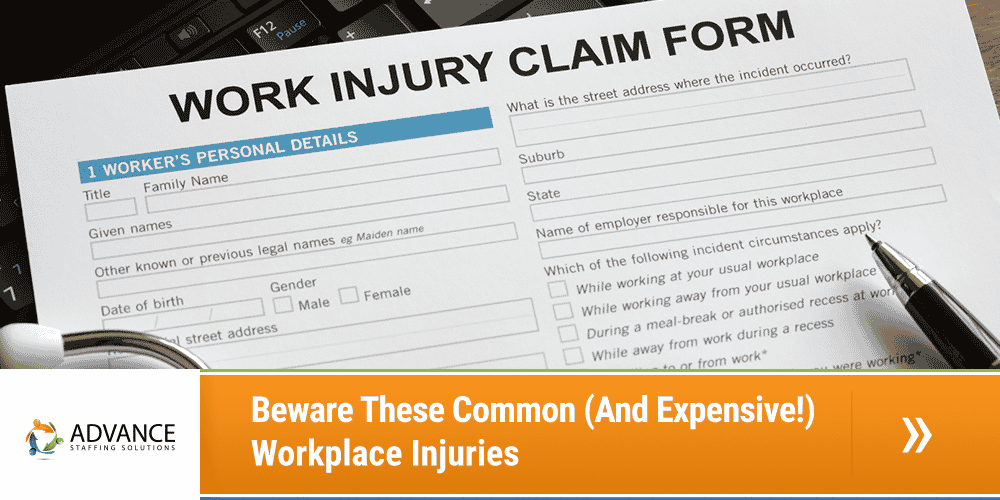
Beware These Common (And Expensive!) Workplace Injuries

Sept_2016_WorkplaceInjuries


Workplace injuries and illnesses cost companies an astonishing $170 billion per year in treatment costs.  By taking the time to develop proper safety procedures, you can reduce your annual costs by approximately 20 to 40 percent, leaving more money to be used for development, growth, or other key business areas.

If you are looking to get serious about preventing workplace injuries and illnesses, start with these key areas.

Proper Materials Handling Techniques

The most common cause of workplace injuries revolves around the improper handling of various workplace materials.  This can include receiving shipments, moving products, or carrying various items.  While many people believe these sorts of injuries are more common in industrial work, they are also quite common in other environments.  This risk is present in manufacturing, retail, construction, shipping, and many other industries.  Issues can even present in traditional office environments when employees must move pieces of equipment, shifting office furniture, or carrying a box of files.

Improper lifting and carrying techniques can lead to a wide variety of injuries, ranging from strains and sprains to contusions and fractures.  Even the smallest workplace injuries of this nature can set a company back over $15,000, while more serious injuries can easily cross $50,000.

By educating employees on proper materials handling techniques, you can lower the risk of injury.  Provide onsite training on a regular basis and keep accessible reading materials available at all times.  Include injury prevention in your new employee orientations, and make sure to review the information often.

Avoiding Slips, Trips, and Falls

Slips, trips, and falls are another common source of injury with a wide range of potential consequences.  Along with all of the risks that can exist with materials handling, injuries of this nature can also lead to more serious injuries including, but not limited to, concussions and joint dislocations.  If employees work at elevation, the risks increase further.  In certain circumstances, a fall can even result in death.

In order to protect employees from the risks associated with slips, trips, and falls, make sure all walkways are clear at all times.  Do not allow cables and power cords to cut across walking paths without being properly covered or secured.  Make sure any spills that can cause a walking surface to become slick are marked immediately with appropriate warning signage and cleaned up as quickly as possible.

If employees must work at elevation, make sure proper safety procedures are reviewed prior to the activity taking place.  This can include anything from ladder safety to the proper use of harnesses and other safety equipment.

Falling and Flying Objects

Falling or flying objects can also occur in any environment.  A heavy item placed on a high shelf can fall if not properly secured, and workplaces with moving equipment may see items accidentally thrown across spaces.  The risks associated with being struck by a falling or flying object vary greatly depending on the size and weight of the object, and the portion of the body being struck.  While some contact may result in cuts or contusions, others may result in fractures, injuries associated with being crushed, dislocations, and even death.

As with other safety areas, proper training is key.  If certain items should not be placed on upper shelves, support training efforts through the use of signage attached to the shelving in question.  Make sure that any items that have the potential to become a falling or flying object are properly secured, or that safety equipment is worn if necessary.

By following the tips above, you will be well on your way to ensuring your employees are better equipped to avoid workplace injuries.  If you are looking for more information about how you can make your workplace safer, contact Advance Staffing Solutions today for a consultation today.


Advance_CTA_ContactAdvanceToday


End Your Industrial Interview with These Never-Fail Questions

Sept_2016_IndustrialInterview


As an industrial interview draws to a close, the last question the interviewer will ask is practically inevitable, yet it leaves a lot of candidates stumped.  When you are faced with the classic, “Do you have any questions for me?” close, take the opportunity to find out what you would like to know about the company.  When in doubt, consider these questions your go-to solution to keep the conversation going.

“Can you describe a typical workday for a person working in this role?”

While many job postings indicate the specific skills that are required to complete certain job functions, they are not always indicative of an average workday.  By asking for examples at the end of your industrial interview, you can see how the hiring manager envisions success in this position.  Additionally, if they have difficulties describing how the position fits into the daily picture, it may show that the details are not entirely known, which could translate into some serious adjustment periods when the position is initially filled.

“How is conflict managed within the organization?”

This question is most useful if the interview is with your potential direct supervisor, but can also provide insight if you are interviewing with another person within the management chain.  You can learn how the prospective supervisor or manager views conflict resolutions, including their personal style or technique.  Depending on the response, this may provide insight to more than just their personal preferences, since an example pulled from a real life experience may show the kinds of conflicts that have occurred previously in that workplace.

“What do you enjoy about working here?”

If the person who is interviewing you is not happy about their current work situation, that stress may flow to those who work for them.  By asking them to speak to the positive parts of being with the organization, you can understand which aspects are valued by the interviewer.  This can help you set expectations as to how certain portions of the environment or work function.  If the interviewer has trouble answering the question, it may be a warning sign that there are issues behind the scenes.

“Over the next five years, how will the company be growing or changing?”

This can also provide insight into how those who work for the organization feel about its current direction.  If the interviewer feels positive about future developments, it will likely show in their response.  However, if the interviewer cannot seem to find something positive to say, or seems incredibly perplexed by the question in general, it may indicate that the future of the organization is not widely known, may be in flux, or may not be entirely positive.

“Do you have any questions or concerns that are preventing me from being your top candidate for this position?”

This opens the door for the interviewer to ask any follow-up questions that may have come to mind during the process, especially in cases where interview processes are standardized in a way that prevents the interviewer from initially delving deeper.  Not only does this show you are confident in your ability to address any concerns, it also provides you an opportunity to address them specifically.  If a concern is presented, answer it completely, and then allow them to continue requesting more information as needed.

If you are looking for additional tips for your job hunt, including information on available positions and help for your next industrial interview, we are here to help!  Contact Advance Staffing Solutions today!


Advance_CTA_SearchOurOpenJobsToday


It’s a Candidate Market – Speed Up Your Hiring Process to Hire the Best Ones!

Sept_2016_CandidateMarket


Hiring processes have lengthened over time.  Many businesses have expanded their requirements to include more than a simple interview.  Some have introduced group interviews, candidate presentations, multiple interview rounds, skills testing, and various skills or personality tests.  As of 2015, the length of the average interview process was estimated at over 22 days.

If you think your lengthy hiring processes may be costing you, you could be right.  With unemployment generally falling and the current candidate market, you can’t afford to wait, and here’s why.

The Best Candidates Don’t Wait Around

While shifts to a more thorough process may seem to make sense from a business perspective, these longer wait times can mean missing out on your ideal candidate.  Those with the most talent likely have multiple opportunities in the works, and being late to the game, or dragging your proverbial feet, can mean that candidate won’t be there when the decision has finally been made.

You May Have to Offer Higher Pay

If the candidate is still there, it may cost you more to get them onboard if they are currently considering other offers.  This can result in a bidding war, putting the candidate in the best negotiating position, and forcing two, potential rival, businesses to have to up the ante to keep the candidate interested.

Lengthy Hiring Processes Cost More Money

Not only do lengthy hiring processes require more time and energy, and could result in a bidding war, there are other costs in play as well.  The longer the position remains vacant, the longer your business is operating without a person in a key position.  If the position is in sales, then the effects may be very easy to see.  For other positions, other staff members are having to work harder, or shift their priorities, to make up for the work that would traditionally be completed by another employee.  If remaining employees are pushed too hard for too long, there may be damaging effects to morale and overall performance.

How to Speed Up Your Hiring Process

You do not have to sacrifice quality in order to speed up your hiring process.  Begin by creating clear job requirements for the official posting.  Focus on those requirements which are more concrete in nature, such as specific software experience, to help quickly remove any candidates who will not make the cut.  Contact any other stakeholders in the business in advance to set aside interview times and dates before candidates are even reviewed.  Avoid scheduling unnecessary interviews with candidates you know will not be suitable in order to fulfill some imaginary minimum.

Once you identify the ideal candidate, contact references and perform any background information quickly.  If it is permitted, inform your prime candidate that they are currently on top and that certain formalities are the only items pending.  Get a contract or formal offer ready, so it can be presented as soon as all required checks are complete.

Consider Outside Support

If your hiring process is still too lengthy, consider working with a staffing firm to help speed up your process, such as the professional at Advance Staffing Solutions.  Not only can they perform prescreening duties on potential candidates, they can also speak with references and run other checks before referring the candidate to the position.  This means, as soon as the right candidate comes along, you can make an offer immediately.

Contact Advance Staffing Solutions today and get your hiring process moving through the candidate market!


Advance_CTA_CheckOutTalentShowcase


Want Your Receptionist Resume Read? Use These Tips

5-want-your-receptionist-resume-read-use-these-tips


There are two phases to getting your resume read. First, you have to get passed the ominous Application Tracking System (ATS), and that can be a feat by itself. Once you’ve cleared that hurdle, you have to entire the recruiter or hiring manager to review the content.

By following certain standards, you can increase the likelihood that your resume will be seen by an actual person and that they will take the time to read it. Before you submit your next resume, use these tips to up your odds.

Format and Structure

While individuality can be great in a lot of circumstances, your resume is not the appropriate time to flex your creative muscles. Resumes adhering to certain guidelines have a better chance of making it passed an ATS, and are more likely to be read once they are in front of a person.

Keep your resume in a .doc or .txt file type. An ATS can read these formats more easily that a PDF. This means it has a better chance of seeing the information you have included correctly, and it will not accidentally interpret the files as being a graphic instead of text. For similar reasons, avoid adding graphics and charts on your resume, as well as a headshot, as these may be problematic for an ATS to manage. Most recruiters aren’t interested in seeing graphical components either, so adding pictures for their benefit is unnecessary.

If you want the ATS to have the easiest time reviewing your work history, make sure you list the name of your current or previous employers before you list the dates when you worked there. That allows the ATS to more accurately follow the chronological order of events and lowers the chance of being rejected just because the system is having issues reading the data. Further, this layout is familiar and allows recruiters to quickly scan for pertinent information regarding your previous experience.

Keywords and Language

In most cases, you can find your ideal keywords from the job posting for the position. Examine the language used, as well as word combinations. If a particular phrase appears within the job posting more than once, consider using the entire phrase instead of single keywords.

You will also want to pepper your resume with keywords in more than one way. While having them featured in a list of applicable skills is helpful, they should also appear throughout the resume body. Add a few to previous work experience descriptions where appropriate to emphasis them for both an ATS and a recruiter. You can also add them to headings and subheadings as an additional way to bring focus to these skills.

Take the time to learn about the organization’s culture and preferred phrases. You may be able to find this information through their website or press releases. If you know someone who works with the company, you can inquire with them as well. Many organizations have their preferences when it comes to communications and the use of industry jargon. By using language similar to the one they tend to favor, you are more likely to seem like a good fit.

Find the Right Positions

The biggest tip to getting your resume read is to apply to jobs for which you are qualified. If you can’t integrate many keywords because they don’t apply to your experience or education, you may be aiming at a job that you aren’t prepared to perform in. If that is truly where you want your career to go, you may need to work on your skills so that you can perform the job duties required.

If you are looking for a new position, and want some assistance getting your resume read, Advance Staffing Solutions can help you get to where you want to be. Contact Advance Staffing Solutions today.


Advance_CTA_SearchOurOpenJobsToday


Sylvania OPEN Registration

Join us tomorrow Friday, January 27th

Open Registration

5800 Monroe St Bldg F

Sylvania, Ohio 43560

8:00am-2:00pm

Please make sure you bring 2 forms of valid ID

State ID/Driver’s License AND Social Security Card/Birth Certificate.

419-882-7646


Monroe – Open Interviews

Open Interviews!

The Advance Group

35 E Front St Monroe MI 48161

Monday, April 10th 9 a.m. to 2 p.m.

                   Multiple openings in Monroe,

  Carleton, Temperance, Dundee, Erie & Petersburg!

         Skilled trades, clerical, manufacturing

      1 ½ to 2 hour registration process

·        Must be 18 years of age or older

·        Must have a High School Diploma or GED

·        Must pass a pre-employment drug screen/background check

·        Must have work history in the last 12 months

**PLEASE BRING 2 VALID FORMS OF ID AND A RESUME**

Desperate for a New Warehouse Job? Use This Advice!


If you’ve been scouring job announcements for months with little to show for it, it can be easy to think that you should just take any new warehouse job that comes along. While this perspective is understandable, it isn’t necessarily the best move for your career.

Whether you’re currently unemployed or stuck in a position that isn’t right for you, taking a bad job that just happens to come along can make you feel even worse and may cause you to miss a great opportunity. To help you determine if a sense of desperation is guiding your choices and leading you to say “yes” to the wrong job, here are some points to consider.

Are You Dealing with Job Search Burnout?

Just like you can reach a state of burnout on the job, the same can happen when you are looking for a new job. You’ve dedicated a significant amount of time and energy trying to find something new, and not getting something positive in return can take a toll on your wellbeing. It can also lead you to accept a position simply because it was offered and you just want the search to be over.

If this sounds like you, and you aren’t in serious financial need to start working a new job right away, consider setting your job search down for a time. Taking a break can give you a chance to destress or reevaluate your priorities, allowing you to return later with a renewed sense of energy and focus. And you don’t have to take a lot of time off to get that boost. Even a week away from the constant scrolling through job postings can be enough.

Will the Job Feel Like a Smart Move in Six Months?

After you’ve been searching for a while, the idea of taking something because it will pay the bills seems like a smart move. However, if the idea of working there for the next six months leaves you questioning that thought, then it’s often better to move on. Accepting a job that you can picture yourself dreading in the near future can put you in a worse position, and often just leads to a new job search. Instead of getting stuck in a cycle of bad jobs and job searches, really consider if the work sounds interesting enough to stick with for a year or more, or if it will at least be a bridge to a position that excites you. If the answer is no, then keep looking.

If you’ve become frustrated with your job search and would like to work with a professional recruiter familiar with high-quality warehouse positions in the area, the team at The Advance Group can help connect you with today’s top employers. Contact us to discuss your career goals and see how our services can take the stress out of your job search.


OPEN INTERVIEWS – Michigan Works Southeast

Join Us tomorrow Tuesday, August 8th 8:30am-10:30am

Michigan Works! Southeast

1040 South Winter Street

Adrian, Michigan 49221

Please bring 2 valid forms of ID

Requirements …

  • 18 years of age or older

  • HS Diploma/GED

  • Work history in the last 12 months

We have multiple openings for ….

  • Welding

  • Assembly

  • Machine Operators

  • Packaging

  • Warehouse

  • Production Workers


Messed Up Your Light Industrial Interview? Bounce Back with These Tips


Sometimes, you leave an interview knowing it didn’t go well. Maybe you stumbled on a few questions or committed a faux pas that didn’t leave a great impression. Regardless of the reason, it’s never a great feeling. Messing up during your light industrial interview isn’t the end of the world, however. There are ways to bounce back. Here are a few tips to help you get back on track.

Let Yourself (Briefly) Grieve

It’s okay to take a little time to feel bad about how things went. Instead of bottling up your feelings, allow yourself to work through the emotions. Don’t make a wide announcement about the how things went, as this can hurt your future prospects, but do consider confiding in one person whom you trust. Vent your frustrations a bit and discuss what happened during the interview. This will let you get everything out of your system, giving you the opportunity to get past it.

Move On

After you’ve taken a day to work through your emotions, it’s time to pick yourself up and start again. Treat your last interview as a learning experience and take it as an opportunity to improve during your next one.

Start by reviewing what went wrong and determine what you can do better next time. Maybe you need to dedicate more time to preparation and practice to help your answers feel more natural or do additional research regarding the interview process or your next target company.

The important thing is to manage your mindset and see your mistakes as an opportunity to grow. Every interview is a chance to learn and improve, and a bad one can teach you a lot of about what not to do and how to perform better next time.

Acknowledge Your Accomplishment

While the interview went poorly, part of the process went right. After all, you did land an interview, and that should be a point of pride. Celebrate this little victory to give yourself a boost and acknowledge that getting that far into the process is an accomplishment that deserves recognition.

Keep Applying

Now that you’ve learned a valuable lesson and gained additional experience, it’s time to work on landing your next interview. This means it’s time to start applying to open positions again to help you find your next opportunity.

Remember, there are other jobs out there, so you’ll get another chance to shine. And don’t forget that your application did help you score your last interview, so you know you can do it again.

If you want assistance with your new job search, the professional recruiters at The Advance Group can help you locate opportunities at some of the top companies in the area. Contact us today to see how our services can connect you to your next opportunity and help you get your career moving in the right direction.