Where Are All the Temps Going? How to Make a Hiring Plan After Peak Season

Where Are All the Temps Going


As the busy season comes to a close, seasonal and temporary employees may be leaving to head back to college or to take other permanent jobs. This can reduce your staff dramatically, which can take a toll on the business and the employees who are left behind. How can you design a hiring plan after the peak season that supports year-round growth and new opportunities to bring on at least a portion of your temps? Here are some helpful tips to accomplish this.

1. Communicate with your temp agency in advance of your hiring goals

The sooner you can let your temporary agency know you intend to hire some of your seasonal workers on permanently, the better. This helps the temp agency screen all employees to find out if they are looking for something for now or for the long term.

2. Provide rewarding projects that challenge seasonal workers

One of the ways to identify employees who may be suitable for long-term hiring needs is to assign tasks and projects that challenge them. This often brings out the leaders in each group of temps, who may be looking for better work opportunities in the future.

3. Understand the skill and knowledge gaps you have

Your seasonal employees may possess the right skills and knowledge that you need to plan your staffing after the peak season passes by. Conduct a thorough analysis of the present skills of your team to find out where there are gaps. Then offer employment opportunities to your seasonal workers who have the right skills to close these gaps.

4. Offer to rehire seasonal workers for next year

You can plan your hiring by offering to rehire the seasonal workers who perform well and who express an interest in coming back again next year. Consider that some of your seasonal workers will be college students who will be looking for careers once they graduate. The sooner you can get them to commit to coming back, the better for your business.

5. Give seasonal workers an incentive to stay employed

If you want to hire at least a portion of your seasonal workers who have done well, you can also offer a sign-on bonus for those who accept permanent placement with your company. Try offering some employment perks too, like benefits and a new office environment to work in.

Use the above tips to help retain your best seasonal workers and boost your company growth as part of a smart recruitment plan. You can secure top seasonal and temp workers from Advance Staffing Solutions.


 

Advance_CTA_WhatAdvanceStaffingCanDoForYourFirm


Your Perfect Hire is a Special Bond – How to Nurture It

Your-Perfect-Hire-is-a-Special-Bond----How-to-Nurture-It


It is not often that a company comes across a perfect hire, but when it does, it is important to nurture the relationship with that hire from the start. The company must build a bond, making it as strong as possible, so the employee stays with the company for the long haul. Nurturing the relationship with a perfect hire can be tricky, but it can be done.

Here, we will discuss three great ways for your company to nurture their relationship with a perfect hire.

1. Share Mutual Passions with the Employee

The old adage “opposites attract” really does not apply when a company is looking for the perfect hire. Companies rely on their employees having the same values and beliefs when it comes to business in order to succeed. When employees do not share the same views as the company, the culture and bottom line will suffer. Because of this, companies must look for employees who share like passions in order to turn them into perfect hires.

In terms of sharing like passions, two important ones are culture and the job opportunity. This can be determined during the job interview. If the candidate does not show enthusiasm for the job, they likely won’t change if hired. The same can be said for the office culture. If the candidate does not seem receptive to the company culture now, there’s a strong chance it will remain the same if hired.

2. Paint a Realistic Picture of the Company

The job interview is the first time you will present your company to a potential employee. It might make you a little nervous at first, but the more realistic a picture you paint, the more receptive the candidate will be to what you have to offer. As the interviewer, you cannot lie about the company or the job because eventually the truth will be set free. If you put on a front or lie, the candidate will likely decline your job offer and even warn others about applying in the future.

3. Seek the Whole Truth

Do your best to seek the truth when screening job candidates. This will help you down the road when cultivating relationships with any perfect hires. It is not uncommon for job seekers to tell tiny lies on their resumes or in their cover letters. You can check their honesty by looking into their social media profiles and other information found on the Internet. If none of it matches up, then you have an issue with honesty. If the candidate boasts how strong their communications skills are, and they submit a strong video resume, then you likely found a truthful candidate.

As you can see, it takes quite a bit to cultivate a relationship with a perfect hire, but the steps are well worth the positive outcome. By making this effort, your company will reap the rewards of a long and positive working relationship with your new hire and will get a good ROI from this.


Advance_CTA_WhatAdvanceStaffingCanDoForYourFirm


5 Ways To Find Hardworking Millennials

5-Ways-To-Find-Hardworking-Millennials


Millennials are overtaking the workforce as baby boomers continue to retire, which is why companies are trying to find new ways to land hardworking millennials. Some are incredibly easy to find because they work internships with a company before receiving an offer of employment. Others might not be so easy to find because they do not want to be found, or are not actively looking for a new job. Use these five tips for finding hardworking millennials.


Check Their Hunger for a Job


One of the best ways to find a hardworking millennial is to check their hunger for a job. There are millennials out there who accept an entry-level job and then walk away from it two weeks to one month later because they feel that they are above the work they are doing, simply because of where they went to school. In order to avoid this type of behavior and attitude, you must perform a hunger check. Tell the candidate up front that they will be doing entry-level work, and if the conversation ends, so be it. If it doesn’t, you might have someone hungry for the job.


Brutal Honesty During the Interview Works


The second method to finding hardworking millennials is to be brutally honest with the candidate during the job interview. Explain to the candidate exactly what the job entails, what you don’t want at your office and what you do expect at the office in terms of behavior and attitude. If the candidate is still sitting there at the end of your speech, they must really want the job.


Be Open to Shaking Things Up


There are companies out there that love employing millennial workers because they know how to handle them. They are open to shaking things up at work. There is nothing wrong with being a fair boss who is also tough on employees. It is one of the best ways to get strong work from employees. In some instances, you have to be like a tough parent with millennials in order for them to perform at the levels they are truly capable of.


Candidates Show Themselves in Interviews


Whether you know it or not, candidates will show their true selves during job interviews. Even if you think they are putting on an act simply to impress you and receive the offer, at some point they will show you who they truly are. If this is the case, and it scares or frightens you, do not hire that candidate. You will only live to regret the decision.


Help Millennials Advance


Do your best to help millennials advance when you find strong ones, even if it means they climb the corporate ladder at a different company. This will help your company build a strong reputation for taking care of employees, which will make it easier to recruit top talent in the future.

Try to use all five of these methods in order to bring in the best talent possible for your company. If you need more help finding and bringing talented millennials or other employees into your workplace, contact Advance Staffing Solutions today! 


Advance_CTA_WhatAdvanceStaffingCanDoForYourFirm


Making Temporary Employees Feel Welcome in Your Workplace

Making-Temporary-Employees-Welcome-in-Your-Workplace


Why do many temporary employees feel awkward and unwanted on the job? Temporary employees generally don’t receive the same attention that permanent hires get, because they are here one day, gone the next. Managers and employees view them as, well, temporary — so no one takes the time to welcome them to the company. Many temps arrive on their first day and get little more than a second glance from other employees.

The problem with this is that the company is losing out on the productivity and performance that a temporary employee can provide if they are made to feel welcome. Investing in an onboarding process for temps is important to the success of an organization. In fact, a temp could become your next great hire so making a positive impression on them from day-one is good for your business.

Here are some ways to make temp employees feel more welcome and valued in your workplace.

  1. Host a temporary orientation session
    Just because someone may be only working for a short period of time for your organization, it’s not OK to skimp on a formal orientation. On the first day of contract work, greet the temp at the front door, show them around the workplace, introduce them to a few key people, and then guide them to an orientation room. If you can group a few temps together, this is even better. Go over the company background, the temp assignment requirements and any special company rules and guidelines.
  2. Assign a team mentor
    For each temp employee, you should assign a more-seasoned employee who can help support this transition into working for your company. This person will be a mentor and will be training the temp on the basic tasks of the assignment for the first few days. Then the mentor will check the temp’s work, give appropriate feedback, and report the progress to the immediate supervisor. Other employees can help this process too, by providing positive feedback and praise to the temp.
  3. Provide a welcoming work environment
    The work environment has as much to do with the temporary employee’s experience. Create a welcoming area for the temp between or near other friendly employees. Give the temp a clean and clutter-free workstation. Encourage the temp to decorate their work space as they like, to give it a personal touch. Provide a comfortable chair, good lighting, and an ergonomic work surface for completing tasks. Have all technology ready to use, company office supplies handy, and a special handbook waiting on their desk to welcome them to their new job.
  4. Offer the temp a free lunch on the first day
    Temps often feel strange about eating lunch on their first day on the job, so you can lessen their worries by offering a free catered lunch to your new worker. Breaking bread with your temps can also help to make others feel welcomed and comfortable. Make it a point to help the temp feel included in any group lunches or outings from here on out, too.
  5. Check in daily with each temporary employee
    To help the temp employee to feel welcomed and supported, touch base in person or by phone at least once a day near the end of the shift. Over time, decrease this to once a week and as needed. The temporary employee will be glad to report their work, ask questions, and get help if needed. This makes them feel welcomed and part of the company objectives.

Need help onboarding temps at your workplace? Let Advance Staffing Solutions do the hard work for you, and you can reap all the benefits of top-notch temporary employees!


Advance_CTA_CheckOutTalentShowcase


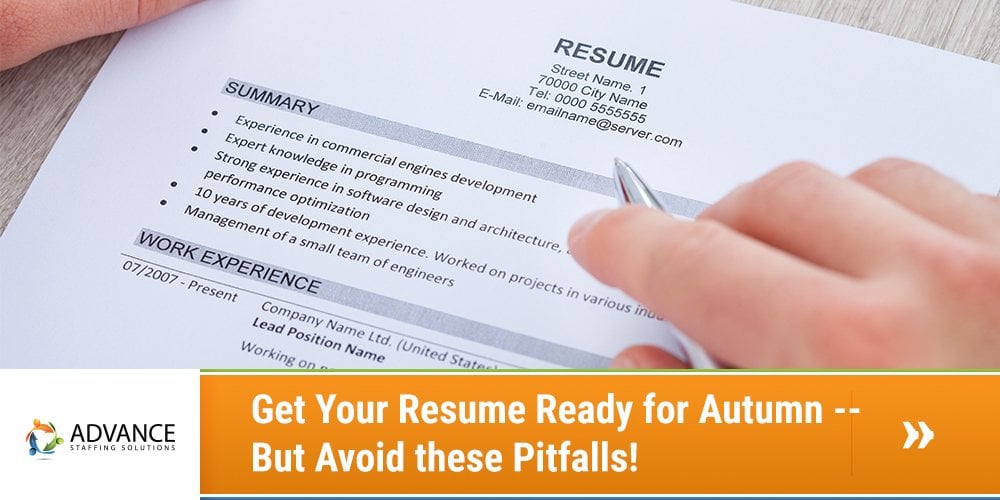
Get Your Resume Ready for Autumn — But Avoid these Pitfalls!

Get-Your-Resume-Ready-for-Autumn-But-Avoid-these-Pitfalls


The cooler months of autumn can be the perfect time to launch a new job search, starting with whipping a resume into shape. A well-designed resume can help you get in front of the best hiring companies. But, before you go through all this effort, make sure your resume doesn’t include any of these common resume pitfalls that can turn off recruiters before they’ve had a chance to meet you.

Pitfall #1 – Your resume is boring

If you fall into the trap of writing your resume on a dull over-used resume template, you can be sure that the recruiters will pass it by. This is because they read through so many resumes daily, so the boring ones get ignored. Take the time to develop your resume on an updated resume template that includes nice use of text, white space, and call-out sections for maximum reader appeal.

Pitfall #2 – Your forgot to include achievements

If your resume reads like a long list of job requirements and responsibilities, without any real accomplishments, it’s missing the mark big time. Make sure you explain briefly what you did in each role and then add a list of at least 2-3 achievements or recognition you had in each job. Even if they were temp assignments, find something. Use financials and percentages whenever you can.

Pitfall #3 – Where is the cover letter?

A good resume includes a cover letter that acts as a quick introduction of your value to hiring managers. Use a similar template to build your cover letter, include a strong opening statement, a list of your top 5 skills you bring to the table, and wrap it up by inviting the recruiter to read your resume and contact you for a job interview.

Pitfall #4 – Your spelling and grammar leave much to be desired

Always take the time to do a spelling and grammar check of your resume, and any written materials you send out to recruiters. If you have issues in this area you can get a friend to proof-read your resume before it goes out for all to see. Poor grammar and spelling tell a company that you are not concerned with the with the quality of your work, and you don’t want to develop this relationship.

Pitfall #5 – Overuse of keywords

In an effort to sound amazing to hiring managers, it’s easy to include a bunch of industry power words in a resume. However, most recruiters are wise to this and they find it annoying. Avoid using too many keywords that make you look like an amateur, instead focus on marketable job skills and knowledge you have.

Follow the above tips to avoid making these common resume pitfalls, and you should look a lot better to hiring companies out there looking for great people this fall.

Job Fair/Open House – jobs in Monroe, Dundee, Milan & Carleton!

Advance Staffing Solutions

35 E. Front St. Monroe, MI 48161

734-457-0056

www.advancestaffingsolutions.com

Tuesday, August 11th, 2015

9am-4pm

Immediate openings available in

Monroe, Dundee, Milan, & Carleton!

Are you in need of a job or looking for a career change? Our Recruiters will be on hand to interview for the following job openings located in the Monroe County area:

  • Machine Maintenance
  • Press Operator/Machine Operator
  • Production/Assembly/General Labor
  • Janitorial/Industrial Cleaning
  • Warehouse/Packaging
  • Welder/Fabricator
  • Administrative/Accounting

Pay rates are based on experience – these are temporary to hire opportunities!

Specific information about our job openings and ability to apply online located on our website www.advancestaffingsolutions.com

  • Bring 2 valid forms of ID and a resume.
  • Must be at least 18 years of age
  • Have a Diploma/GED
  • Verifiable work experience in the last 12 months.

*Not able to make it to our Open House/Job Fair but would like to be considered for a job opening? No problem! You can either send us your resume at monroejobs@advancestaffingsolutions.com or go to our website and apply online. Recruiters review resumes and applications on a daily basis and will contact you within 48 hours of receiving your information.

You’re Losing Top Talent Because…

Youre-Losing-Top-Talent-Because


A certain amount of employee turnover is to be expected, particularly in tough industries that chew up and spit out people on a regular basis. But, when turnover rates remain high or become unusually high; there’s a problem. As a human resource or recruitment professional engaged in the active pursuit of talent, the issue of losing top talent can become a frustrating and costly issue.

Asking yourself why you are losing top talent to the competition? Here’s some of the hidden reasons this may be happening.

Not offering the best possible compensation

The number one reason why employees leave companies, according to workforce surveys, is because they do not believe they are being paid fairly. To prevent the loss of your best talent, make sure that all job types are matched to current salary surveys for the skills, knowledge, and region they exist. Provide above-industry benefits and other perks of employment.

Did not use an onboarding process

Not having a formal onboarding process for new hires is a recipe for disaster. It sets employees up for failure, even months after they are working for your company, because they feel lost and have no clear direction. If you match employees up with more seasoned employees, after a brief onboarding week, your talent is less likely to slip through the cracks. The extra bonus is that they can be more productive sooner.

Forgot to prepare managers to do their jobs well

People often leave companies over conflicts with managers and team leaders. When this is the case, and they do not feel supported by a manager who is interested in their career success, the only alternative is to seek employment elsewhere. To prevent losing talent this way, provide career training for managers on a continual basis, and have an open-door policy for mediating any employee and management problems in a safe environment.

Neglected to provide promotional opportunities

Most working professionals want to move up the corporate ladder. If you want to keep good people, then it seems like a no-brainer to provide opportunities to be promoted into higher positions in the organization. Not doing this well? Then it’s probably in your best interest to start doing some succession planning efforts around the workplace.

The company mission statement is out of sync with the culture

Perhaps your employees are leaving because what they thought was a good match for their work style, based on your corporate culture, is really not the case? Take a good long look at what your mission statement and vision is about, then evaluate whether or not your corporate culture fits into this context. If not, it could be time to survey your employees to come up with better ways of communicating and promoting the work culture that fits the mission of your company.


Advance_CTA_CheckOutTalentShowcase


When is the Right Time to Start Planning Your Hiring?

When is the Right Time to Start Planning Your Hiring

Running a company is incredibly difficult, and one of the most important parts of it is hiring new employees. Many companies tend to wonder when the right time is for planning the next round of hiring. The simple answer is … now! Companies need to put together their hiring plans as soon as possible in order to prepare for unexpected staffing needs. The sooner you have the plan created, the easier it will be to implement the plan when the times comes. Below, we will discuss when the right time is and how to create that plan.


Look at the Present Workforce


When you begin to put together a hiring plan, take a long look at your present workforce. There is nothing written in stone that you need to find a new employee from outside the organization. In fact, there might be some diamonds in the rough within your current workforce. Give a current employee a chance to improve their skills by promoting them to an open position that you might otherwise fill from outside the company. Invest in the job satisfaction of your current employees in order to put together a plan that helps you find future employees based on collaboration.


Develop a Plan That Meets Two Needs


Your hiring plan must meet two different needs for your company. Those two needs are staffing for the present and staffing for how you see your company growing in the future. When you have a hiring plan in place, you make it easier to deal with the risks and costs of hiring part-time, full-time, permanent, temporary or temp-to-hire employees. Your hiring plan will be able to ensure that hiring is consistent across all of the departments within the company. The plan needs to have a process for hiring in the present and in the future when you need to expand.


Perform an Analysis of Jobs at Your Company


An important part of putting together a hiring plan is to perform an analysis of the jobs at your company right now. Even though a job might open up, does it need to be filled immediately? Take a look at how it might fit into your company’s plans in the near future. How did the job fit into the company’s plans in the past? Was the job more effective in the past? Will it be more effective if it is altered in the future? Take a long, hard look at all of the jobs at your company and analyze them when putting together a hiring plan.

The definitive answer to the question posed in the title of this article is that now is the right time to start planning your hiring. The longer you wait, the more difficult it will be to find new talent.


Advance_CTA_WhatAdvanceStaffingCanDoForYourFirm


Do You Know Your REAL Hiring Needs?

Do You Know Your REAL Hiring Needs

As a hiring manager, you may always be on the lookout for quality employees to add to your organization. This is especially true if you are in an industry with typically high turnover rates or difficult to fill positions. However, over-hiring can pose problems for the organization too – leading to lack of work for all employees, low productivity, and eventual layoffs due to budget problems. This is why it’s important to take the time to analyze your real hiring needs every so often.

Before you hang the “Help Wanted” sign, take the time to know your real hiring needs, with this quick checklist.

Step 1 – Develop accurate job descriptions, salaries and requirements.

Every job changes over time, which is why you need to keep up with each job’s description of responsibilities, requirements, and salary needs. Keep your job descriptions up to date by working with front line managers and observing employees on the job periodically. This will help you maintain a focus on real needs in the organization.

Step 2 – Evaluate current workforce skills and gaps.

You are hiring for skills and knowledge, not just to add more warm bodies. Identify the key skills and keep them on board, hiring replacements only if someone leaves who has these skills. As new projects arrive that demand more skills, hire for them.

Step 3 – Identify and move the most productive employees upward.

Chances are, you already have some high performing employees on your team who are ripe for some succession planning. Give them a promotion and move them into next-level positons, then focus your new hiring on replacing skills at the entry level.

Step 4 – Determine short-term and long-term hiring needs.

Taking a look at current client projects and incoming projects, it’s time to break up your hiring needs into two categories. These are staffing for short term and for long term goals. Bring in temporary contractors for short-term programs, and temp to perm employees for more long term projects.

Step 5 – Create training programs to develop team skillsets.

Determining your real hiring needs most often comes down to updates in the industry that demand top skills and knowledge of new technology. This is where training comes into place. Training can be focused on immediate project needs or on long-term goals for cross training the entire organization. Hire knowledge experts to transfer their information to your current employees whenever possible.

Step 6 – Partner with a staffing agency to maintain the candidate pipeline.

Your staffing agency can be a great source of support when it comes to hiring only for real needs. It is a more flexible option, with part time and full time employment options, short and long-term contracts, and many of the hiring costs are handled upfront by the agency. This maintains the right skills for your organization with a never-ending supply of pre-screened candidates.

If you follow the above tips, you can ensure that your company will be in better tune with actual hiring needs.


Advance_CTA_CheckOutTalentShowcase


Is Your New Hire Your Next Superstar?

Is Your New Hire Your Next Superstar

It’s every hiring manager’s dream to place someone in a new job and then, weeks later, discover that he or she has star potential. When a new hire is driven to success early on, it means that they not only make themselves look good, but your company does too. High performance candidates can be hard to spot, and they are rare indeed, but the person sitting across from you at the interviewing table could be your next superstar employee. Here’s how to find out.

Know what a superstar employee is

The definition of a superstar employee is someone who provides an above average ROI once you bring them on board. Mitchell Harper co-founder of Big Commerce defines superstars as, “someone who will generate 5x the important performance indicator of a normal person. For example, a superstar engineer will crank out 5x as much quality code as a normal engineer.” In other words, a superstar consistently outperforms other employees and rises to the top of the team quickly.

Choose the candidate qualities you want

When hiring, its critical to understand what factors will make a candidate become a future rock star employee. Make a list of the top 5 characteristics of your top performance employees, then focus on this as you read through resumes, meet with candidates, and evaluate their skills and abilities. It’s not always a certain personality type, but it’s the desire to make a difference in the industry that sets these candidates apart from others.

Use an assessment to weed out the “talkers”

One way to cut through the chatter when trying to identify your best prospects in stellar candidates is to use candidate assessment tests. People generally will say and do just about anything to get a job, including stretching the truth about their experience and skills. Give candidates a chance to prove they have what it takes to be on top.

Look for a progressive career advancement

Highly-driven candidates are concerned with career advancement and their work histories will show this. Unless they’ve been laid off in the past, you will usually see a progression of personal and career growth, including ongoing learning activities and advancing areas of responsibility. Look for candidates who have a mind and heart for business, as the entrepreneurial spirit is a sign of a superstar candidate.

If you see these characteristics in your candidate, take the time to dig deeper to see if he or she may be a good fit for your company. Need help recruiting amazing candidates? Look to the support of Advance Staffing Solutions today.


Advance_CTA_ContactAdvanceToday


Why You Should be Recruiting More Passive Candidates

Why You Should be Recruiting More Passive Candidates


In the recruitment market, there is always a push for hiring the highest quality of candidates, and placing them in the jobs that are the best match. But this often poses as a huge challenge, because these great candidates are hard to find in high-demand industries. This is when recruiters turn to passive candidate recruitment methods to seek out professionals who may not be currently looking for a job right now, but whom have the right qualities for placement in an upcoming job order. Here are several reasons you should be recruiting more passive candidates for your organization.

What is it about passive candidates that is so appealing to recruiters?

You may be asking yourself, “Why would I want to put any energy out trying to recruit passive candidates, if they are already employed by someone else?” This is a valid question, but it goes much deeper than this. Passive candidates often represent the cream-of-the-crop in terms of the types of candidates you want to build a relationship with. They have several key advantages over active candidates, including:

  • They’ve already earned the experience and accolades that are desired by top companies, so their value is greatly elevated.
  • They have excellent references and backgrounds that are desired by companies, so you can leverage this for negotiating higher placement fees.
  • They are well connected with other leading candidates, so once you have won a passive candidate over, their colleagues will follow – making your job as a recruiter easier.

These are just a few advantages you will find when working with passive candidates. How can you start attracting and building a nice pipeline of passive candidates? Read on for some tips on finding and recruiting passive candidates.

3 ways to find and recruit passive candidates

Use these tips for finding those top passive candidates and getting them on board.

1. Use a personalized recruitment approach

Instead of sending out canned email messages that sound “salesy,” why not take a more personalized approach to meeting passive candidates? Connect with them on social networks and at local business networking events. Introduce yourself, what you do, and how you can help them reach their career goals. Then follow up in a non-threatening way, maybe over a cup of coffee.

2. Find out what passive candidates want

As early as possible, get to know what each passive candidate is looking for in terms of the next level of their career growth. Maybe they are already at the top of their game and are looking for a change? Be open and just ask them outright what they may be looking for in the next three-to-five years.

3. Offer passive candidates what they want

Now that you have an idea of what a passive candidate wants, stay in touch and offer them opportunities to get to know some of your best clients. Work out a strategy to get them a position that meets their needs with one of your companies. Go one step beyond what other recruiters are offering with a sweet compensation and career growth package they cannot resist.


Advance_CTA_WanttoKnowMore

5 Reasons Why Happy Employees are Better Employees

5 Reasons Why Happy Employees are Better Employees


Is a happier workforce somehow better? Many workplace experts believe so. A recent PayScale report indicates that as many as 70 percent of American employees currently working are unhappy and unfulfilled at work. This leads to several problems, including high employee turnover rates and low productivity levels. This is costing businesses billions of dollars in lost revenues.

In this article, we will talk about the matter of employee happiness and give five reasons why a happy workforce adds up to better employees.

Reason 1. Employees produce 10 percent more work when they are happy

A University of Warwick (UK) study showed that when workers were happy and satisfied with their jobs, productivity increased by as much as 10 to 12 percent over previous levels of job performance. This means that if your workers are happy, they are more engaged and probably working harder to achieve their goals. The company ultimately benefits from this effort.

Reason 2. Happy employees tend to stick around longer than unhappy ones

As stated earlier, the PayScale report indicated that happy employees are getting to be harder to create. When employees are given the right compensation, rewarding tasks, and opportunities to shine, they are more apt to stay in there for the long haul. Loyal employees equate to greater employee retention rates and the chance to get some ROI from recruitment efforts.

Reason 3. Engaged employees create more sales revenues for the company

A Gallup poll published in a popular psychology journal indicated that employees who are happy and engaged in their jobs tend to generate more sales revenues over time for the companies they work for – as much as $300 billion in the year studied. The very perception of working for a great company creates more favorable attitudes towards promoting the company, and this includes backing up company offerings to get more sales.

Reason 4. Happy employees tend to infect the organization with more happy employees

When employees are happy and they show it at work, this tends to reflect on the corporate culture. Humans are more apt to follow their peers. A positive attitude and performance of even a single employee encourages others to feel the same way.

Reason 5. Happy employees help to bring in other happy employees through referrals

If employees are truly happy in their jobs, they are usually willing to refer their colleagues to the company. This means your company can gain access to some of the best passive candidates out there, without as much of the work that goes into sourcing them.

Take steps to find out what makes your employees happy, put effort into creating a better corporate culture, and your organization can benefit from the above perks.


Advance_CTA_CheckOutTalentShowcase