Important Information on Michigan’s Paid Leave


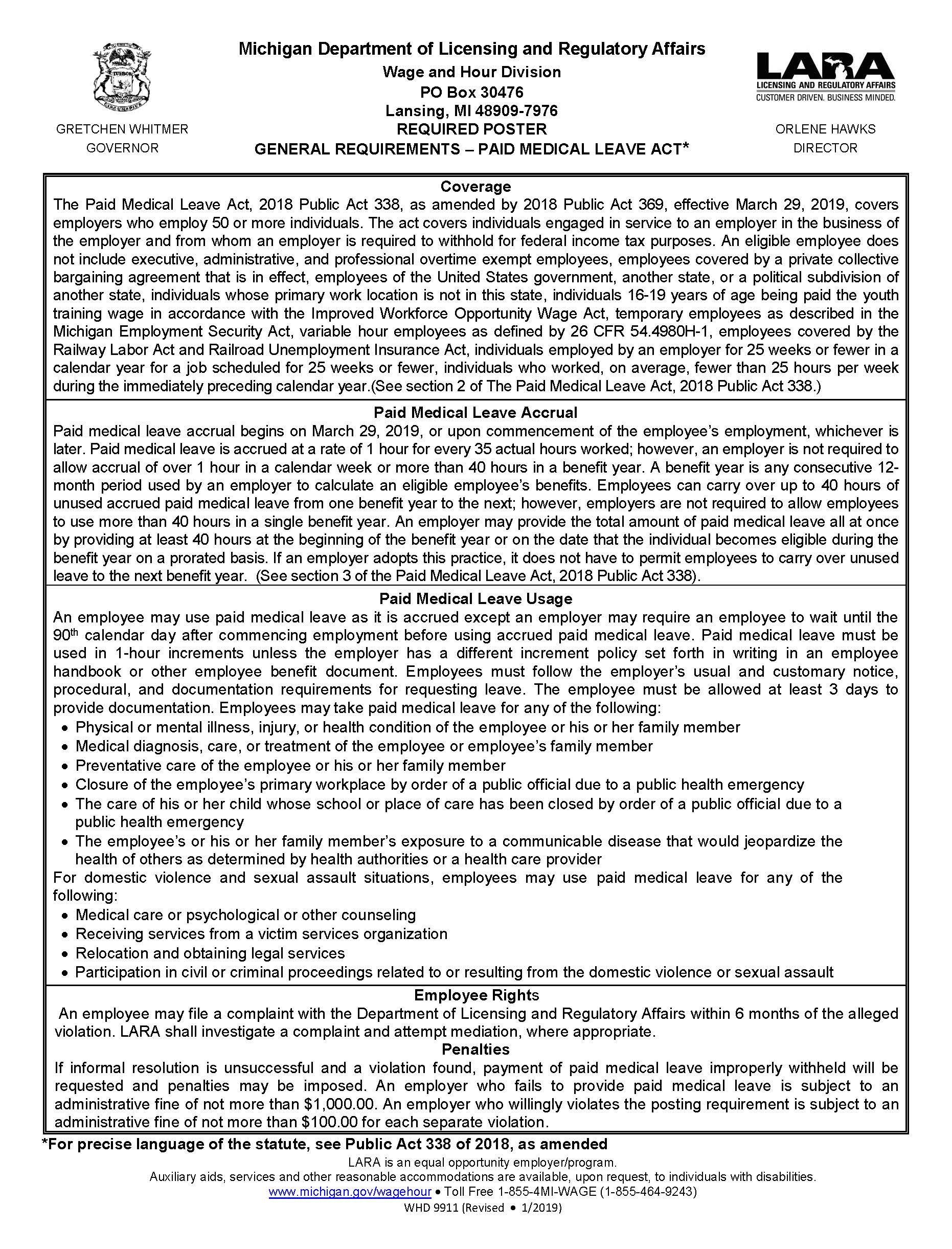
Michigan’s Paid Medical Leave Act will take effect on March 29, 2019.  The Act requires most employers in Michigan to provide up to 40 hours of paid medical leave for certain eligible employees to use for the employee’s own medical condition, to care for a family member’s medical condition, and in other emergency situations.  The state’s required posting regarding the Paid Medical Leave Act is below for your reference.

The Paid Medical Leave Act also applies to the Advance Group’s temporary employee workforce.  As with all payroll and benefit issues, Advance will fully administer this leave program and the Act’s related compliance obligations for the temporary employees who are assigned to our clients.  The Paid Medical Leave Act contains provisions that prohibit all employers from retaliating against employees for properly using their paid medical leave benefits, so employees who meet the eligibility requirements and are placed at our clients’ companies will be permitted to take paid medical leave pursuant to the Act and Advance is unable to make assignment decisions based on medical leave eligibility or use.

The Paid Medical Leave Act permits employees to use time off for unforeseeable emergencies, so there may be instances where an employee calls off to take advantage of this benefit.  Advance instituted strict call off procedures to require as much employee notice as the law permits and requires medical or other documentation to substantiate all absences so the paid leave is not abused.  Advance instituted these guidelines to provide the least amount of disruption as possible to its clients as the new law takes effect.  If you have any questions about Advance’s compliance procedures with the Paid Medical Leave Act, please contact your account representative.


Important Information on Michigan’s Paid Leave


Michigan’s Paid Medical Leave Act will take effect on March 29, 2019.  The Act requires most employers in Michigan to provide up to 40 hours of paid medical leave for certain eligible employees to use for the employee’s own medical condition, to care for a family member’s medical condition, and in other emergency situations.  The state’s required posting regarding the Paid Medical Leave Act is below for your reference.

The Paid Medical Leave Act also applies to the Advance Group’s temporary employee workforce.  As with all payroll and benefit issues, Advance will fully administer this leave program and the Act’s related compliance obligations for the temporary employees who are assigned to our clients.  The Paid Medical Leave Act contains provisions that prohibit all employers from retaliating against employees for properly using their paid medical leave benefits, so employees who meet the eligibility requirements and are placed at our clients’ companies will be permitted to take paid medical leave pursuant to the Act and Advance is unable to make assignment decisions based on medical leave eligibility or use.

The Paid Medical Leave Act permits employees to use time off for unforeseeable emergencies, so there may be instances where an employee calls off to take advantage of this benefit.  Advance instituted strict call off procedures to require as much employee notice as the law permits and requires medical or other documentation to substantiate all absences so the paid leave is not abused.  Advance instituted these guidelines to provide the least amount of disruption as possible to its clients as the new law takes effect.  If you have any questions about Advance’s compliance procedures with the Paid Medical Leave Act, please contact your account representative.


This One Thing Can Make a Big Difference to Your Employees

Employees look to their manager for guidance, and not just in regards to their daily duties or critical projects. They often see them as role models and mentors as well, and they want your input to help them shape their careers.

However, figuring out how to approach the topic can seem daunting. After all, you do not want to give them advice that does not pan out, potentially leading them down the wrong path.

Luckily, there is one thing you can do that can make a massive difference in the lives of your employee and those around you. Here’s what you need to know.

Encourage Them to Think Big

Most professionals have a basic plan of where they want to be in the future. However, they may be limiting themselves, even if they are fairly ambitious, partially because they have never considered certain paths viable or within reach.

You can inspire your employees to overcome these barriers by encouraging them to think big. For example, if a team member has a career plan that involves new skills, but they do not mention moving into leadership roles, ask them how they feel about the idea.

The purpose is to challenge them with something that is more ambitious than their current goal. Get them to consider more than just what they have their eyes on today, as it may broaden their horizons and help them realize their potential.

Plus, if you genuinely believe they are capable of what you are proposing, your faith in their abilities will further inspire them. This is especially true if they view you with respect and as an authority on the matter, increasing the odds they will take the question seriously.

It only takes a moment for you to spark an idea in the mind of a talented professional, so it is worth sitting down with your employees individually and helping them explore what is possible.

Offer Concrete Steps When Possible

If you can go further than just presenting an idea by also offering them an opportunity to take a step forward, do it. Often, even those with big ambitions do not always know how to begin or where they can find the opening they need to make progress. If you have it within your power to provide a concrete plan that can make that new goal a reality, you are not just inspiring them to strive for greater success; you are enabling them to achieve their dreams.

Ultimately, these small conversations can be very powerful, increasing the odds your employees will reach their full potential. If you would like to know more, the professionals at The Advance Group can help. Contact us for a free staffing consultation or to discuss your questions with a member of our skilled team today and see how our expertise can benefit you and your employees today, tomorrow, and well into the future.

This One Thing Can Make a Big Difference to Your Employees

Employees look to their manager for guidance, and not just in regards to their daily duties or critical projects. They often see them as role models and mentors as well, and they want your input to help them shape their careers.

However, figuring out how to approach the topic can seem daunting. After all, you do not want to give them advice that does not pan out, potentially leading them down the wrong path.

Luckily, there is one thing you can do that can make a massive difference in the lives of your employee and those around you. Here’s what you need to know.

Encourage Them to Think Big

Most professionals have a basic plan of where they want to be in the future. However, they may be limiting themselves, even if they are fairly ambitious, partially because they have never considered certain paths viable or within reach.

You can inspire your employees to overcome these barriers by encouraging them to think big. For example, if a team member has a career plan that involves new skills, but they do not mention moving into leadership roles, ask them how they feel about the idea.

The purpose is to challenge them with something that is more ambitious than their current goal. Get them to consider more than just what they have their eyes on today, as it may broaden their horizons and help them realize their potential.

Plus, if you genuinely believe they are capable of what you are proposing, your faith in their abilities will further inspire them. This is especially true if they view you with respect and as an authority on the matter, increasing the odds they will take the question seriously.

It only takes a moment for you to spark an idea in the mind of a talented professional, so it is worth sitting down with your employees individually and helping them explore what is possible.

Offer Concrete Steps When Possible

If you can go further than just presenting an idea by also offering them an opportunity to take a step forward, do it. Often, even those with big ambitions do not always know how to begin or where they can find the opening they need to make progress. If you have it within your power to provide a concrete plan that can make that new goal a reality, you are not just inspiring them to strive for greater success; you are enabling them to achieve their dreams.

Ultimately, these small conversations can be very powerful, increasing the odds your employees will reach their full potential. If you would like to know more, the professionals at The Advance Group can help. Contact us for a free staffing consultation or to discuss your questions with a member of our skilled team today and see how our expertise can benefit you and your employees today, tomorrow, and well into the future.

This One Thing Can Make a Big Difference to Your Employees


Employees look to their manager for guidance, and not just in regards to their daily duties or critical projects. They often see them as role models and mentors as well, and they want your input to help them shape their careers.

However, figuring out how to approach the topic can seem daunting. After all, you do not want to give them advice that does not pan out, potentially leading them down the wrong path.

Luckily, there is one thing you can do that can make a massive difference in the lives of your employee and those around you. Here’s what you need to know.

Encourage Them to Think Big

Most professionals have a basic plan of where they want to be in the future. However, they may be limiting themselves, even if they are fairly ambitious, partially because they have never considered certain paths viable or within reach.

You can inspire your employees to overcome these barriers by encouraging them to think big. For example, if a team member has a career plan that involves new skills, but they do not mention moving into leadership roles, ask them how they feel about the idea.

The purpose is to challenge them with something that is more ambitious than their current goal. Get them to consider more than just what they have their eyes on today, as it may broaden their horizons and help them realize their potential.

Plus, if you genuinely believe they are capable of what you are proposing, your faith in their abilities will further inspire them. This is especially true if they view you with respect and as an authority on the matter, increasing the odds they will take the question seriously.

It only takes a moment for you to spark an idea in the mind of a talented professional, so it is worth sitting down with your employees individually and helping them explore what is possible.

Offer Concrete Steps When Possible

If you can go further than just presenting an idea by also offering them an opportunity to take a step forward, do it. Often, even those with big ambitions do not always know how to begin or where they can find the opening they need to make progress. If you have it within your power to provide a concrete plan that can make that new goal a reality, you are not just inspiring them to strive for greater success; you are enabling them to achieve their dreams.

Ultimately, these small conversations can be very powerful, increasing the odds your employees will reach their full potential. If you would like to know more, the professionals at The Advance Group can help. Contact us for a free staffing consultation or to discuss your questions with a member of our skilled team today and see how our expertise can benefit you and your employees today, tomorrow, and well into the future.


This One Thing Can Make a Big Difference to Your Employees


Employees look to their manager for guidance, and not just in regards to their daily duties or critical projects. They often see them as role models and mentors as well, and they want your input to help them shape their careers.

However, figuring out how to approach the topic can seem daunting. After all, you do not want to give them advice that does not pan out, potentially leading them down the wrong path.

Luckily, there is one thing you can do that can make a massive difference in the lives of your employee and those around you. Here’s what you need to know.

Encourage Them to Think Big

Most professionals have a basic plan of where they want to be in the future. However, they may be limiting themselves, even if they are fairly ambitious, partially because they have never considered certain paths viable or within reach.

You can inspire your employees to overcome these barriers by encouraging them to think big. For example, if a team member has a career plan that involves new skills, but they do not mention moving into leadership roles, ask them how they feel about the idea.

The purpose is to challenge them with something that is more ambitious than their current goal. Get them to consider more than just what they have their eyes on today, as it may broaden their horizons and help them realize their potential.

Plus, if you genuinely believe they are capable of what you are proposing, your faith in their abilities will further inspire them. This is especially true if they view you with respect and as an authority on the matter, increasing the odds they will take the question seriously.

It only takes a moment for you to spark an idea in the mind of a talented professional, so it is worth sitting down with your employees individually and helping them explore what is possible.

Offer Concrete Steps When Possible

If you can go further than just presenting an idea by also offering them an opportunity to take a step forward, do it. Often, even those with big ambitions do not always know how to begin or where they can find the opening they need to make progress. If you have it within your power to provide a concrete plan that can make that new goal a reality, you are not just inspiring them to strive for greater success; you are enabling them to achieve their dreams.

Ultimately, these small conversations can be very powerful, increasing the odds your employees will reach their full potential. If you would like to know more, the professionals at The Advance Group can help. Contact us for a free staffing consultation or to discuss your questions with a member of our skilled team today and see how our expertise can benefit you and your employees today, tomorrow, and well into the future.


Does Your Resume Do You Justice?


Modesty is often considered a virtue, but it doesn’t always serve you well when you are looking to land a new job. Selling yourself short on your resume can cause you to miss out on opportunities, including an amazing new position.

At its core, a resume is a marketing document, so you need to treat it as such. By using it to sell your experience, skills, and achievements, you increase your odds of standing out in the eyes of the hiring manager, making it more likely that you will be called in for an interview.

If you don’t know if your resume is going you justice, here’s what you need to consider.

Is Your Resume an Attention-Grabber?

Researchers have long said that a hiring manager only reviews a resume for a few seconds initially. This means you just have a couple of moments to grab their attention. Otherwise, they are going to move on to the next candidate.

Ideally, your resume needs to be filled with short statements that pack a punch. Strive to highlight your accomplishments and relevant skills, showcasing exactly why you are right for that particular role.

Are You Overly Modest?

Your resume is an opportunity to politely brag about what you bring to the table. Often, job seekers fear that, if they are too assertive, the hiring manager may assume they are arrogant.

While this can certainly happen if you are overly aggressive, there are ways you can brag that comes off as confident, not arrogant. For example, embracing active instead of passive voice when you discuss your accomplishments is a great way to start. It makes your resume engaging and highlights your trust in your abilities without arrogance.

Using strong action words – like “achieved,” “identified,” “generated,” “solved,” and “upgraded” – also helps your resume pack a punch without going too far.

Did You Include Numbers?

Quantifying your accomplishments is always the best approach. Not only do numbers visually stand out, drawing the hiring manager’s attention, but they also provide valuable context about your achievement.

For example, “Increased sales” is not nearly as impactful as “Increased sales by 20 percent.” Dollar amounts are similarly powerful, so add them whenever appropriate.

Can You Back It Up?

You can’t just tell the hiring manager you are great; you have to prove it. On your resume, make sure to include clear examples that highlight your achievements. Let them know about the situation, the tasks you needed to perform, the challenges you encountered, how you reached success, and the results of your work. Also, discuss any of the relevant skills involved in achieving the resolution, especially if they align with your target role.

By following the tips above, you can ensure your resume is doing you justice. If you would like to learn more about running an effective job search and finding open jobs in Michigan and Ohio, the team at The Advance Group can help. Contact us to speak with one of our staff members today and see how our resume writing expertise can benefit you.


Does Your Resume Do You Justice?


Modesty is often considered a virtue, but it doesn’t always serve you well when you are looking to land a new job. Selling yourself short on your resume can cause you to miss out on opportunities, including an amazing new position.

At its core, a resume is a marketing document, so you need to treat it as such. By using it to sell your experience, skills, and achievements, you increase your odds of standing out in the eyes of the hiring manager, making it more likely that you will be called in for an interview.

If you don’t know if your resume is going you justice, here’s what you need to consider.

Is Your Resume an Attention-Grabber?

Researchers have long said that a hiring manager only reviews a resume for a few seconds initially. This means you just have a couple of moments to grab their attention. Otherwise, they are going to move on to the next candidate.

Ideally, your resume needs to be filled with short statements that pack a punch. Strive to highlight your accomplishments and relevant skills, showcasing exactly why you are right for that particular role.

Are You Overly Modest?

Your resume is an opportunity to politely brag about what you bring to the table. Often, job seekers fear that, if they are too assertive, the hiring manager may assume they are arrogant.

While this can certainly happen if you are overly aggressive, there are ways you can brag that comes off as confident, not arrogant. For example, embracing active instead of passive voice when you discuss your accomplishments is a great way to start. It makes your resume engaging and highlights your trust in your abilities without arrogance.

Using strong action words – like “achieved,” “identified,” “generated,” “solved,” and “upgraded” – also helps your resume pack a punch without going too far.

Did You Include Numbers?

Quantifying your accomplishments is always the best approach. Not only do numbers visually stand out, drawing the hiring manager’s attention, but they also provide valuable context about your achievement.

For example, “Increased sales” is not nearly as impactful as “Increased sales by 20 percent.” Dollar amounts are similarly powerful, so add them whenever appropriate.

Can You Back It Up?

You can’t just tell the hiring manager you are great; you have to prove it. On your resume, make sure to include clear examples that highlight your achievements. Let them know about the situation, the tasks you needed to perform, the challenges you encountered, how you reached success, and the results of your work. Also, discuss any of the relevant skills involved in achieving the resolution, especially if they align with your target role.

By following the tips above, you can ensure your resume is doing you justice. If you would like to learn more about running an effective job search and finding open jobs in Michigan and Ohio, the team at The Advance Group can help. Contact us to speak with one of our staff members today and see how our resume writing expertise can benefit you.


Use These Tips to Make Safety Training Engaging


Engagement is critical for the learning process. If the material or approach do not capture the attention of your employees, your safety training will not be as effective. This could result in knowledge gaps, injuries, or worse, simply because your team was not giving the training their full attention.

Finding ways to make your safety training engaging is essential if you want to protect your workers and the company. If you do not know where to begin, here are some tips.

Find Your Priorities

Your training program should align with your safety priorities. Often, this requires a full risk assessment, ensuring you understand your biggest threats as well as which employees are most at risk.

Examine workspaces, tasks, equipment, processes, and anything else that can shine a light on potential issues within your company. As you perform your review, also look at any near misses that could indicate a problem even when there is not an actual injury associated with the event.

Then, you can target these points specifically during your training, ideally at the beginning of the session when everyone is most alert. This increases the odds your priorities will be addressed at a time when recall and retention capabilities are at their peak.

Select the Right Approach

Using the best training approach based on your employees’ preferences is a must. While some workers may be able to tolerate a long lecture, others will start to tune out fairly quickly, so it might not be the best option if you want to increase engagement. Similarly, not everyone thrives if you use computer solutions for independent learning, especially if they are distracted by their duties, face constant interruptions, or are not particularly tech-savvy.

Research different training options and see which one (or ones) best align with your company goals and your workers’ preferred learning styles. That way, you can select an approach that is more likely to engage your staff, increasing their recall and retention.

Make Safety Training Part of Your Culture

When workplace safety is an aspect of your culture, you do not have to rely on formal training to increase learning. Instead, make every accident, near miss, or issue a training opportunity, encouraging people to explore solutions and learn how they can avoid the problem in the future.

Inadvertently, this approach also promotes bite-sized training, which may be more digestible. Instead of long sessions, you are focusing on single topics for a short period, making it easier for employees to stay engaged during the discussion.

While this may not substitute for formal training, it can increase safety awareness quickly and efficiently, ensuring your workforce always has safety on their mind.

If you would like to know more about effective safety training options, the professionals at The Advance Group can help. Contact us for a free staffing consultation and see how our workplace safety expertise can benefit you.


Use These Tips to Make Safety Training Engaging


Engagement is critical for the learning process. If the material or approach do not capture the attention of your employees, your safety training will not be as effective. This could result in knowledge gaps, injuries, or worse, simply because your team was not giving the training their full attention.

Finding ways to make your safety training engaging is essential if you want to protect your workers and the company. If you do not know where to begin, here are some tips.

Find Your Priorities

Your training program should align with your safety priorities. Often, this requires a full risk assessment, ensuring you understand your biggest threats as well as which employees are most at risk.

Examine workspaces, tasks, equipment, processes, and anything else that can shine a light on potential issues within your company. As you perform your review, also look at any near misses that could indicate a problem even when there is not an actual injury associated with the event.

Then, you can target these points specifically during your training, ideally at the beginning of the session when everyone is most alert. This increases the odds your priorities will be addressed at a time when recall and retention capabilities are at their peak.

Select the Right Approach

Using the best training approach based on your employees’ preferences is a must. While some workers may be able to tolerate a long lecture, others will start to tune out fairly quickly, so it might not be the best option if you want to increase engagement. Similarly, not everyone thrives if you use computer solutions for independent learning, especially if they are distracted by their duties, face constant interruptions, or are not particularly tech-savvy.

Research different training options and see which one (or ones) best align with your company goals and your workers’ preferred learning styles. That way, you can select an approach that is more likely to engage your staff, increasing their recall and retention.

Make Safety Training Part of Your Culture

When workplace safety is an aspect of your culture, you do not have to rely on formal training to increase learning. Instead, make every accident, near miss, or issue a training opportunity, encouraging people to explore solutions and learn how they can avoid the problem in the future.

Inadvertently, this approach also promotes bite-sized training, which may be more digestible. Instead of long sessions, you are focusing on single topics for a short period, making it easier for employees to stay engaged during the discussion.

While this may not substitute for formal training, it can increase safety awareness quickly and efficiently, ensuring your workforce always has safety on their mind.

If you would like to know more about effective safety training options, the professionals at The Advance Group can help. Contact us for a free staffing consultation and see how our workplace safety expertise can benefit you.


Performance Management Tips for 2019


Performance management is a critical business process. When properly used and implemented, it helps keep your employees productive, ensuring everyone has the information they need to succeed.

However, if your performance management process is lacking, you might not be seeing great results. If you want to make sure your approach is on target, here are some performance management tips for 2019.

Update Your Job Descriptions

The job description for each position defines the expectations for the role. It outlines the position’s purpose, duties, and key responsibilities, serving as a guide for what the employee needs to accomplish.

Without clear and updated job descriptions, you can’t identify critical KPIs, outline expectations, or create goals for the worker. Without these points, effective performance management is incredibly challenging, if not outright impossible.

Take some time to review all of the job descriptions and adjust them if needed. While it may take some time, it is crucial for company and staff success.

Identify Priorities

Once you have the job descriptions updated, find any priority duties or responsibilities for each position. This gives you critical areas of focus as it allows you to determine which potential issues are the most damaging, ensuring managers concentrate on these areas when evaluating performance or providing feedback.

Define Expectations

An employee can’t meet your needs if they don’t know what they are, so defining all expectations regarding their performance is a must. Then, you need to share these details with the worker, ensuring they are well informed regarding what they need to do and what standards they need to meet.

Adopt a Continuous Approach

After the previous steps are complete, adopting a continuous approach to performance management is usually best. Annual or quarterly reviews aren’t always the most effective, as they rely on reviewing missteps with employees long after the incident occurs.

Instead, encourage managers to be active in the process. When they see an employee is struggling or on the wrong path, have them intervene quickly. Similarly, if a worker is performing above expectations, make sure their manager lets them know their efforts are seen and appreciated.

Now, this doesn’t mean you have to abandon formal reviews, especially since they often ensure an employee’s performance is well-documented. Plus, they can create opportunities to reinforce feedback given previously or assess their progress, making them beneficial.

The important part is to stop seeing performance management as being tied to a calendar. Instead, it should be part of the overall culture, empowering managers to provide feedback and guidance at the right moment, even if a formal review isn’t on the horizon.

By following the tips above, you can improve your approach in 2019 and beyond. If you would like to learn more about effective performance management, the skilled team at The Advance Group can help. Contact us to discuss your company’s goals for 2019 with one of our knowledgeable staff members today and see how our performance management expertise can benefit you.


Performance Management Tips for 2019


Performance management is a critical business process. When properly used and implemented, it helps keep your employees productive, ensuring everyone has the information they need to succeed.

However, if your performance management process is lacking, you might not be seeing great results. If you want to make sure your approach is on target, here are some performance management tips for 2019.

Update Your Job Descriptions

The job description for each position defines the expectations for the role. It outlines the position’s purpose, duties, and key responsibilities, serving as a guide for what the employee needs to accomplish.

Without clear and updated job descriptions, you can’t identify critical KPIs, outline expectations, or create goals for the worker. Without these points, effective performance management is incredibly challenging, if not outright impossible.

Take some time to review all of the job descriptions and adjust them if needed. While it may take some time, it is crucial for company and staff success.

Identify Priorities

Once you have the job descriptions updated, find any priority duties or responsibilities for each position. This gives you critical areas of focus as it allows you to determine which potential issues are the most damaging, ensuring managers concentrate on these areas when evaluating performance or providing feedback.

Define Expectations

An employee can’t meet your needs if they don’t know what they are, so defining all expectations regarding their performance is a must. Then, you need to share these details with the worker, ensuring they are well informed regarding what they need to do and what standards they need to meet.

Adopt a Continuous Approach

After the previous steps are complete, adopting a continuous approach to performance management is usually best. Annual or quarterly reviews aren’t always the most effective, as they rely on reviewing missteps with employees long after the incident occurs.

Instead, encourage managers to be active in the process. When they see an employee is struggling or on the wrong path, have them intervene quickly. Similarly, if a worker is performing above expectations, make sure their manager lets them know their efforts are seen and appreciated.

Now, this doesn’t mean you have to abandon formal reviews, especially since they often ensure an employee’s performance is well-documented. Plus, they can create opportunities to reinforce feedback given previously or assess their progress, making them beneficial.

The important part is to stop seeing performance management as being tied to a calendar. Instead, it should be part of the overall culture, empowering managers to provide feedback and guidance at the right moment, even if a formal review isn’t on the horizon.

By following the tips above, you can improve your approach in 2019 and beyond. If you would like to learn more about effective performance management, the skilled team at The Advance Group can help. Contact us to discuss your company’s goals for 2019 with one of our knowledgeable staff members today and see how our performance management expertise can benefit you.