Emotional Intelligence Tips for Every Employee

Navigating the professional world can be tricky. While a person’s technical capabilities are critical for their success, emotional intelligence is just as essential. Without emotional intelligence, interacting with others effectively is challenging. With it, you’re better equipped to understand your feelings as well as the emotions of others, enabling you to consider them as you engage with colleagues.

The soft skills involved ensure you can interact effectively, appropriately, and professionally, allowing you to be a better leader, team member, and contributor. Developing stronger emotional intelligence is typically a good idea for everyone. If you’d like to learn how you can enhance vital soft skills to support higher emotional intelligence, here are some tips that can help.

Understand the Key Measures of Emotional Intelligence

A variety of skills and capabilities go into emotional intelligence. Empathy often plays a big part, as it allows a person to understand situations from the perspective of another party. Self-assessment is another factor, as it gives a person the ability to recognize how their choices impact others.

Those with high emotional intelligence also tend to be disciplined. They can recognize a potential reaction to a situation growing and have the ability to actively decide not to allow it to come to fruition if it would be harmful or unjustified. The capacity to acknowledge one’s emotions while also keeping them in check is a powerful tool, enabling people to build functional working relationships.

How to Improve Your Emotional Intelligence

Everyone can enhance their emotional intelligence. By focusing on the right soft skill areas, you can become more skilled at understanding and navigating potentially complex situations.

First, learning to be mindful is beneficial. This includes both the capacity for looking inward as well as being able to remain in the present, ensuring emotional hurt from the past doesn’t inappropriately impact an action today.

Learning to listen actively is also critical. The practice of remaining engaged when someone else speaks ensures you aren’t focused on formulating an answer while another person is still expressing themselves. You won’t risk missing an important detail because you were distracted by planning your next move. Plus, it promotes actions like summarizing what was said to ensure you fully understand and asking thoughtful questions to encourage clarity, both of which lead to better relationships.

Finally, practicing self-assessments makes a difference. Learning to check-in with yourself allows you to gauge your underlying emotional state and increase your awareness of your feelings. Then, you are empowered to make wiser decisions by ensuring that something you are incidentally carrying with you doesn’t influence your choices moving forward.

Ultimately, emotional intelligence is critical for all professionals, regardless of their position or status as a leader. If you’d like to learn more about excelling on the job, the staff at The Advance Group can help. Contact us today and see how our workplace communication and collaboration expertise can benefit you.

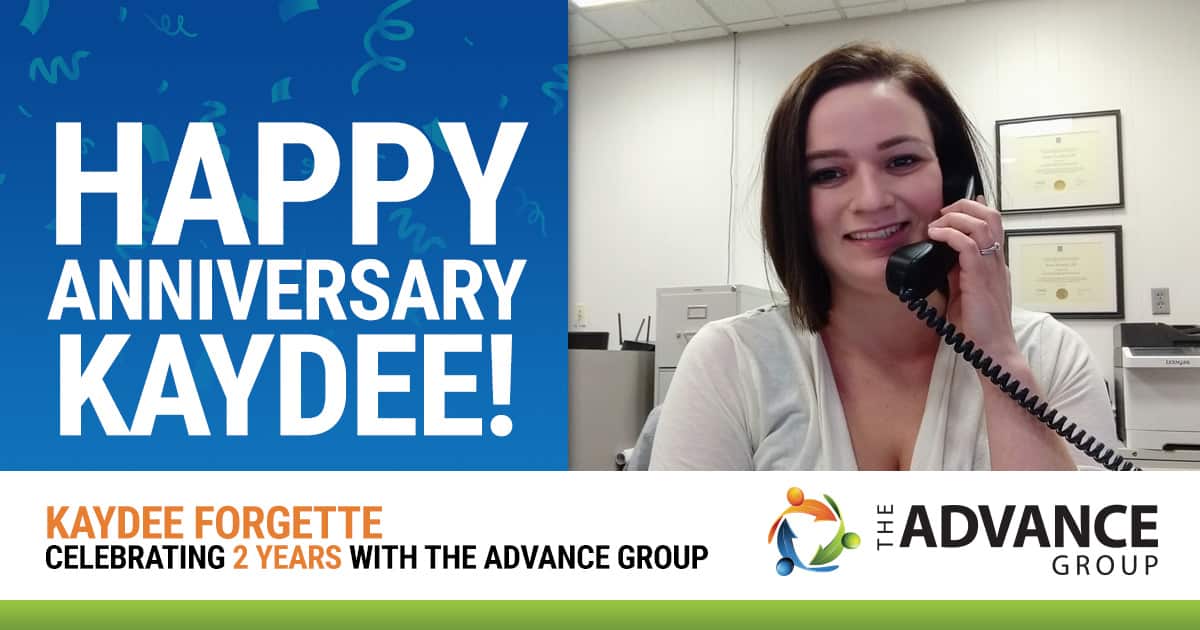


Happy 2nd Anniversary, Kaydee Forgette!


To celebrate Kaydee Forgette’s 2nd year with The Advance Group, we sat down with her for a Q & A session.  Here are a few highlights to enjoy:

Q: What are the last three items you purchased on your credit card?
A: L’ange hair products/ hair tools, clothes & fall throw pillows.

Q: What’s your favorite holiday?
A: My favorite holiday is actually a tie between Christmas and Halloween.

Q: What’s your favorite band?
A: The Beatles

Kaydee is a Staffing Coordinator and works in our Sylvania and Monroe branches.  Happy Anniversary, Kaydee!

How to Support Successful Remote Work

There are a lot of pluses that come with working remotely, both for employers and employees. It may be easier to maintain work/life balance, boosting morale. Productivity can often be higher thanks to the reduction in interruptions that make it simpler to focus.

However, remote work also has its fair share of challenges. It’s hard for colleagues to maintain or cultivate strong professional relationships and to communicate effectively. This can lead to feelings of loneliness and isolation, as well as hinder progress on group projects. Adapting to telecommuting from a technical perspective can also be difficult, especially for professionals who aren’t as tech-savvy.

Luckily, employers can step up and make a difference. If you want to support successful remote work, here are some tips that can help.

Create Structure

While flexibility is one of the most significant benefits of remote work, that doesn’t mean that being completely structureless is a good idea. There needs to be a robust, reliable remote work strategy at the heart of the paradigm.

Ideally, managers should set clear expectations regarding deliverables, both when it comes to quality and timing. Additionally, standards regarding work hours should be outlined, whether that involves being available at certain times of the day or simply completing a set number of hours during a 24-hour period.

Communication guidelines also need to be in place. This could encompass a regular check-in schedule, mandatory meeting participation, and similar activities.

A bit of structure ensures everyone is adhering to the right standards and routines. That way, everyone can remain on target.

Update Your Culture

Many companies had to become remote-first practically overnight due to the COVID-19 pandemic. As a result, changes were instituted quickly, using more of an emergency approach than a thought-out strategy.

Now that the direst part of the situation has passed, it’s time to reevaluate. While keeping a remote-first mindset may be required for some time, it’s vital to consider what that actually means for your organization.

Often, a remote-first culture focuses on keeping employees involved regardless of whether they are in the workplace. It’s about seizing opportunities to promote their success, soliciting their input before making company-wide decisions, and similar approaches that ensure their perspective is considered.

Additionally, companies need to make sure that a remote-first culture doesn’t morph into an always-on one by mistake. Letting workers know that being available 24/7 isn’t expected is critical, ensuring they know that they can disconnect when their workday is done.

Review Your Technology

Technology is a critical part of the remote work equation. However, you can’t just install collaboration software and video conferencing solutions and expect that to be enough. While those systems are essential, you have to think further. Whether that’s evaluating your VPN for ease-of-use and effectiveness, revamping your virtual desktop infrastructure (VDI) to enhance accessibility, or identify opportunities to streamline common support requests, it’s worth doing.

Robust, reliable, user-friendly technology boost engagement and productivity. As a result, it’s wise to review your tech to see if it is actually meeting the needs of your workforce, ensuring they are ultimately set up for success.

If you’d like to learn more about supporting your remote employees, the staff at The Advance Group can help. Contact us today.


How to Maximize Your Time After a Layoff

A layoff is a challenging experience, regardless of whether you saw it coming. It means being unemployed, usually through no fault of your own, and often leads professionals to worry about their careers.

While being laid off is traumatic, to a degree, it can also be the start of something amazing. By maximizing your time, you can turn a negative situation into a positive one. If you want to make the most of your new circumstances, here are some tips that can help.

Feel Your Feelings, But Move On

The moment you’re notified of a layoff, it’s normal to feel a range of emotions. If you enjoyed your job, you might feel sad. If you weren’t the biggest fan of your position, you might feel some relief, mixed with a dose of worry. In either of those situations, you might experience a bit of panic about your career or financial stability.

No matter what emotions go coursing through you, it’s fine to spend a moment feeling them. Acknowledge the hurt, anger, relief, excitement, or anything else that comes with the situation. Then, once you’ve had a chance to experience that, prepare to move on.

Dwelling on your layoff won’t help you keep on track. While it may not be easy, letting those feelings go is a critical step. That way, you can refocus on what’s going to come next, allowing you to keep your career on target.

Reflect a Bit

While you might think you need to start looking for new opportunities immediately, you may want to pause for a second before you do. Once you’ve acknowledged and moved on from your initial emotional response to the layoff, take a moment to reflect on your career.

Getting laid off creates a natural opening for change. If your current path doesn’t feel right for any reason, you have a chance to steer it in a new direction.

Consider which skills you did and didn’t enjoy using in your last job. Figure out if your previous industry was a good fit. Research other positions that you may be suited for, using your transferable skills as a guide to identify options.

Your goal should be to determine if a new path is what you need or if you still believe that your current one is a good match. That way, when you do launch a job search, you can take it in the right direction from the beginning.

Explore Your Passions

Most professionals fall into a bit of a routine. With a layoff, that pattern is disrupted. While this may seem like a bad thing, it can also be an opportunity. It gives you time to explore your passions, reigniting your interest in your current field, or giving you a chance to try out something different.

If you’ve been laid off, find opportunities to get involved in activities that inspire you. Try volunteering for an organization that matters to you, allowing you to keep your skills up and serve in a meaningful position while you plan your next step as a professional. Take a class in an area that interests you to boost your resume and keep yourself sharp.

Your goal should be to find ways to feel positive about the future holds and to rejuvenate yourself professionally. That way, as you launch a job search, you can keep your energy levels high.

Ultimately, a layoff is a challenge that many professionals contend with at some point. By using the tips above, you can maximize your time, ensuring your career can keep moving forward. If you’d like to learn more, the team at The Advance Group can help. Contact us today.


Do You Need to Change Your Leadership Style Post-COVID?

Today, it still isn’t entirely clear what a post-COVID-19 landscape will look like, mainly because the situation remains fluid. While re-opening efforts are moving forward, there’s also the looming threat of a resurgence. Additionally, it isn’t known when an effective treatment or vaccine will be widely available.

During unprecedented times, the leadership approaches of yesteryear may not be ideal. After all, the landscape has changed dramatically in an incredibly short time. Plus, figuring out what the “new normal” is and will be isn’t easy. Without the right kind of leaders, companies will struggle.

Luckily, it is possible to adjust your leadership style to meet the challenges of the moment. If you are wondering if or how you should change, here’s what you need to know.

A Willingness to Learn Is a Must

Now isn’t the time for leaders to dig their heels in and assume they know best. The pandemic is an anomaly, and no one has experience navigating a situation of this nature.

If you want to lead effectively, it’s time for a mindset change. A willingness to learn isn’t a luxury for any manager or employee; it’s essential.

Ideally, you want to create a learning culture. Showcase that you understand that gathering knowledge is crucial while also acknowledging that, even if you don’t have all of the answers, you’re open to using the right resources to get them.

Additionally, be open to the expertise of others, including members of your team. They may have ideas that work particularly well in this oddity of a landscape, but you’ll only know if you actively ask them to contribute and genuinely consider what they share.

Adaptability and Flexibility Are Crucial

While rigidity may have provided your workplace with structure, it isn’t ideal today. Managers and employees are facing challenges that they would never have anticipated. Company leaders need to recognize the uniqueness of the situation, first and foremost. That way, they can have an open mind about being adaptable and flexible, increasing they can embrace unconventional or empathetic solutions when the need arises.

Along with keeping track of industry happenings, allowing you to be agile from that perspective, you also need to check in with your team frequently. Gauge how they are doing and find out if they are struggling personally or professionally. If they are facing an obstacle, see if there’s a way for you to reduce their burden or help them overcome it. That way, you are setting them up for success and decreasing their odds of burnout, both of which are important.

Become Safety-Oriented

Technically, the safety of workers should always be a priority. However, it’s even more crucial now that there is a risk that you can’t eliminate or control.

Many professionals are concerned about their health, as well as the well-being of their loved ones. When it comes time to make any decisions regarding operations, adopt a safety-first mindset. That way, the health of everyone is the first thing you consider, ensuring you make choices that will keep everyone as safe as possible.

Ultimately, adjusting your leadership style might be a crucial step. Use the tips above to ensure you head in the right direction. If you’d like to learn more, the staff at The Advance Group can help. Contact us today.


Get Your Forklift Training Certificate – Without Leaving Home!

Many professionals enjoy operating equipment. Becoming a forklift driver is one of the easiest ways to get started. After all, they are present in nearly every warehousing or industrial environment. Plus, job opportunities are fairly plentiful.

However, to launch a career as a forklift operator, getting your forklift training certificate is a must. Usually, this is relatively simple, as it can be handled on a job site. But during COVID-19, that isn’t always an option.

Luckily, there’s an alternative. You can get certified without leaving home, all by completing your training online. If you want to find out why certification is important and how you can finish training without leaving home, here’s what you need to know.

The Importance of Forklift Certification

Some professionals might wonder why being forklift certified matters. Luckily, the answer is incredibly simple: the Occupational Safety and Health Administration (OSHA) requires forklift operators to be certified.

Without a forklift certification, you technically aren’t eligible to operate a forklift on the job, even if your employer is a small company. Additionally, you need written authorization from your company, not just verbal confirmation, stating that you can operate the forklift.

The reason for the stringent requirements is mainly that forklifts are heavy equipment. Additionally, they can be incredibly dangerous, especially if the person driving it isn’t well trained or knowledgeable about how to use one properly.

Even after initial certification, forklift operators have to renew their certification every three years. That way, they can learn about any changes in operating procedures or safety standards.

Similarly, if a driver is in a forklift accident, is observed using one in an unsafe manner, or is working in an environment that undergoes a physical change, they have to do a renewal immediately. This ensures they have the right information at a time when it could be needed most.

Where to Get Forklift Training

Forklift training is actually available in a few ways. Traditionally, it’s handled in-person. An employee might be able to complete the course at a designated training facility or their employer’s location. It begins with classroom learning, and is followed by hands-on training.

However, in-person training isn’t the only option. There are online forklift certification training programs available, allowing professionals to handle the requirement without having to leave home.

How to Use Online Forklift Training Options

Online forklift certification can be a great alternative to in-person training. As long as the program is OSHA recognized and is valid in your state, it can be a viable approach.

There are two options for accessing online forklift training. First, a professional can choose to pay for it themselves, an approach that could be ideal for landing your first forklift job.

Second, employers can pay for online classes. With this, a company handles the cost of training and ensures the right team members get access to the coursework.

Once signed up, you access to class and review the material. Along the way, you’ll typically take quizzes or exams, showcasing that you understood what was covered.

In the end, if you pass the exam, you are certified. It’s that simple. You can move forward with your forklift operator career, as the major requirement is handled.

If you’d like to learn more about working as a forklift driver, the team at The Advance Group can help. Contact us today.


How to List Remote Work on Your Resume

Today, we are increasingly living in a remote-first world. Many employers now understand the benefits of allowing employees to telecommute. Plus, the COVID-19 situation is still fluid, and many companies are embracing remote work approaches for the foreseeable future as a result.

If you have remote work experience, that may make you a stronger candidate in the eyes of remote-first employers. That means you want to showcase it, allowing you to demonstrate your success as a telecommuter.

Luckily, it’s easy to position your remote work experience properly. Here’s how to include it the right way on your resume.

Include Remote Work Experience in Your Professional Summary

Your professional summary should always be tailored to the position you want to land. If you’re going for a remote job and have prior experience telecommuting, highlight it in your summary.

You can discuss the number of years you’ve been part of a remote workforce, as well as telecommuting-specific skills or achievements along with industry- or field-specific ones. That way, the hiring manager does not doubt that you’ve telecommuted in the past successfully.

Showcase Remote Work-Oriented Skills

If you have a skills section under your professional summary, work in a few that relate to your remote work experience. You could include relevant telecommuting technologies as a starting point, or add “remote” to the bullet point.

For the latter approach, for example, “project management” could become “remote project management.” However, you could also simply list “remote work/telecommuting” as a skill, if you want to single it out specifically.

Update Your Job Title to Highlight Remote Work

If you previously worked in a position that was remote from the beginning, consider updating your job title to reflect that. For example, if you were a contact center customer service representative, you may want to list your job title as “Remote Contact Center Customer Service Representative.” That allows the hiring manager to see that the position always involved telecommuting.

However, you could add a note about your remote experience, even if the job didn’t always involve telecommuting. After your job title, in parenthesis, you could add “In-Office/Remote.” With that, the hiring manager would know that you telecommuted at least part of the time.

Put “Remote” for the Location

Another option for a completely remote position is to forgo, including the employer’s city and state for the location. Instead, you’d list “remote” or “telecommute,” showing that you weren’t heading into a physical workplace while handling those duties.

There are other approaches you can also use. For example, “Remote – City, State” or “City, State (Remote)” shows that you were telecommuting but also allows you to provide a pertinent detail about your employer.

Mention Remote Accomplishments

Generally, discussing your achievements instead of just your duties is the best way to catch a hiring manager’s eye. If you want to make sure that your remote experience is highlighted in your resume, include accomplishments that occurred while you were telecommuting. That way, you can integrate that vital detail into the description of that achievement.

For example, instead of leading off an accomplishment with “Managed a 12-person project team…,” you could say, “Remotely managed a 12-person project team…” That allows you to subtly discuss your telecommuting experience without having to separate it from your achievements.

Ultimately, all of the tips above can help you include remote work in your resume. If you’d like to learn more, the team at The Advance Group can help. Contact us today and see how our resume writing expertise can benefit you.


Which Lessons Learned from the Pandemic Apply to Your Business?

Looking to fire up your marketing or recruiting?

Let us help light the fire! Just tell us which deals you’d like to know more about…​

A content area for the offer

Lorem ipsum dolor sit amet

Lorem ipsum dolor sit amet, consectetur adipiscing elit. Ut elit tellus, luctus nec ullamcorper mattis, pulvinar dapibus leo. Lorem ipsum dolor sit amet, consectetur adipiscing elit. Ut elit tellus, luctus nec ullamcorper mattis, pulvinar dapibus leo.

Awarded Industry Leader

We're proven to be industry leaders in service quality based entirely on ratings provided by their clients and the employees they’ve helped find jobs.

Our Difference

Lorem ipsum dolor sit amet.

Lorem ipsum dolor sit amet, consectetur adipiscing elit. Ut libero nisl, rhoncus vel enim at, scelerisque sagittis ante.

Useful Statistics

Lorem ipsum dolor sit amet.

Lorem ipsum dolor sit amet, consectetur adipiscing elit. Ut libero nisl, rhoncus vel enim at, scelerisque sagittis ante.

Better yet, let’s talk.

Give us a call or schedule a call and we’ll help you figure it out!

Call us 1.800.123.4567

Unemployed? Do These 3 Things Today!

When you’re unemployed, your first priority is often finding new opportunities. While a job search can certainly be a lot of work, that doesn’t mean it’s the only thing you should be doing with your time.

Certain other activities can be incredibly beneficial. If you’re unemployed and want to set yourself up for long-term success, here are three things you need to be doing.

1. Volunteering

When you volunteer strategically, you can accomplish several things. First, you can make sure that there isn’t a gap in your resume. By finding a position where you can put your professional skills to work, you are keeping your skills relevant and maintaining your capabilities, both of which play in your favor.

Second, volunteering can be incredibly rewarding. If you are supporting a cause you care about, there are intrinsic benefits. Feeling like you are making a difference can be a big morale booster. That can make it easier to keep your energy levels up while you look for a new job, and may make you more resilient if you encounter difficulties along the way.

2. Skill Building

A period of unemployment can be an ideal time for skill-building. You can focus on complicated coursework, increasing the odds that you can grow your capabilities relatively quickly.

Along the way, you also make yourself a stronger candidate. You can market your new skills and add them to your resume, which may qualify you for more opportunities, too.

Plus, if you sign up for college courses, boot camps, or other formal learning opportunities you can add to your resume, you are also preventing a gap. Hiring managers often view educational pursuits as being as valid as working, so the time away from the workforce won’t damage your prospects.

3. Brand Building

If you haven’t revamped your online brand recently, now is a perfect time. Along with refining your LinkedIn, Facebook, or other profiles you’ll use during your job search, you can spend time establishing your expertise.

For example, you can create blog posts that highlight your knowledge base. Additionally, you can engage with thought leaders, join professional groups, and otherwise engage with others who are interested in your niche.

With a little bit of time, you can enhance your online brand. Then, as you’re applying for jobs, it can work in your favor. Remember, many hiring managers research candidates online. By boosting your brand, you increase the odds that they’ll be impressed by what they find.

Plus, it may make you more attractive to recruiters. It’s a way to job search passively, as an intrigued recruiter may reach out to you about opportunities, instead of you having to initiate the first contact.

Ultimately, all three of the steps above are smart if you are unemployed. If you’d like to learn more, the staff at The Advance Group can help. Contact us to speak with one of our recruiters today and see how our job search and career advancement expertise can benefit you.



Pre-COVID Pay Rates Just Won’t Cut It…

While the COVID-19 pandemic led to widespread unemployment, that doesn’t mean employers shouldn’t consider raising their pay rates. Competitive salaries are critical for attracting top talent, and, today, employers don’t just have to outdo their competitors; they also have to outshine the government.

In response to COVID-19, unemployment compensation was boosted. Along with extending eligibility, allowing people to claim benefits for longer, funds were directed to provide unemployed individuals with more income. If you aren’t exceeding what people can receive without having to work, you might not capture attention from candidates.

Luckily, there are some simple moves you can make to ensure your post-COVID rates and benefits make sense. If you want to attract top talent, here’s what you need to know.

Reevaluate Starting Pay

Generally, entry-level or low-experience positions are most likely to need a pay boost in a post-COVID world. That way, they can exceed what a person gets through unemployment benefits, increasing interest in the position.

For example, your warehouse positions may need to start at $15 per hour. Since forklift jobs require a specific skill, begin those at $17 per hour. Then, if you operate beyond a single shift, consider a shift differential to make less desirable schedules enticing.

Stabilize Schedules

If a person can make ends meet on unemployment, they aren’t going to settle on just any job. Most professionals don’t like instability in their schedules, including changes to their start and end times or short-notice mandatory overtime.

While you may not be able to avoid some changes entirely, aim to stabilize employee work schedules as much as possible. Try to keep start and end times consistent. If overtime is an issue, consider having some contingent workers you can bring in or a part-time, weekend shift to cover it instead.

Offer Flexibility

COVID-19 is still an issue, creating a degree of uncertainty in daily life. Employers who can offer some flexibility, as a result, will be favored, as they support workers who may need to navigate something unexpected.

For example, have policies in place that help employees who may have trouble if a childcare center or school has to close unexpectedly due to the virus. Expand sick leave use options to cover more COVID-related scenarios, including the need to voluntarily quarantine after possible exposure.

Focus on Safety

Safety has been thrust into the spotlight due to COVID-19. Establish clear policies and strict procedures to ensure your workforce is as protected as possible. If you require PPE, try to make it available to your staff at no cost to them. Communicate openly about your efforts, as well as provide information should a situation develop at your workplace.

Update Screening Requirement

Reducing barriers to entry could increase your talent pool, allowing you to reach candidates who may have what it takes to thrive but would typically be screened out. Consider focusing on potential instead of existing hard skills, for example. If an employee has the right attitude, they can often be trained in a task, so keep that in mind when choosing candidates.

If you’d like to learn more about how to adapt your hiring practices to a post-COVID world, the team at The Advance Group can help. Contact us today.


This Hiring Secret Is Good News for Michigan Businesses

Many Michigan businesses have been struggling with hiring challenges. Before the COVID-19 pandemic, unemployment was low, especially in specific sectors like technology. If your goal was to secure in-demand talent, you ran the risk of positions remaining open for a period, a move that could result in a better quality higher put sacrificed productivity in the long-term.

Today, Michigan is facing new difficulties. The COVID-19 made specific traditional hiring mechanisms, mainly in-person interviews, highly undesirable. However, it also created a shift in the available workforce, leading to a unique opportunity.

If your Michigan company has had trouble hiring in the recent past, here’s a secret that spells good news for your business.

Many Talented Professionals Are on the Market

The COVID-19 pandemic created an unexpected situation. Stay-at-home orders and the elimination of operations for many non-essential businesses resulted in widespread layoffs. At times, companies had little choice but to let their entire staffs go, as they simply didn’t have the income or funds available to support their workforce.

Many of those who were laid off are exceptionally talented. They lost their jobs through no fault of their own, as their employers would have happily kept them on board if circumstances were different.

Additionally, a reasonable percentage of these professionals were passive candidates at best. Some of them actually had no intention of seeking out new opportunities until they were caught in a COVID-19 layoff.

As a result, there are skilled professionals actively seeking out positions today who typically wouldn’t be on the market. This creates a unique opportunity for employers, particularly those who need in-demand skillsets for their open positions.

How to Take Advantage of the Talent Influx

If your company has hiring needs and wants to take advantage of the increased availability of talent, you have to act quickly. Just as before, candidates with in-demand skills won’t stay on the market for long, even with the pandemic still creating concerns in the background. Companies are going to scoop them up fast, so you can’t afford to delay.

Additionally, you need to be reasonable. While high unemployment numbers may make it appear as if you can lower your salary offers and still land a great candidate, that isn’t actually the case. Many professionals were receiving a substantial amount of unemployment, so they aren’t forced to take a below-market-value offer. Plus, many employers are going to see the value these top performers bring to the table, so there’s a good chance your competition is going to make a firm offer if they get the chance.

Ultimately, the hiring landscape in Michigan is changed, at least for the time being. That’s good news for employers who need to fill vacancies, as you may be able to secure quality candidates that weren’t previously available.

If you want to access to some of Michigan’s most talented job seekers, the team at The Advance Group can help. Contact us to speak with one of our recruitment specialists today and see how our hiring services can make reaching top candidates easier than ever before.


These Job Skills Are More Valuable Than Ever

Many hiring managers figured out that technical prowess doesn’t guarantee an employee’s success. While foundational hard skills may be necessary for starting in the role, missing ones can also be taught with relative ease.

However, that isn’t always the case with soft skills. Typically, these traits are a bit innate, a reflection of a person’s personality, and how they navigate the workplace. They aren’t easily taught, as they are more frequently learned over time and through life experience.

As a result, hiring for soft skills has become increasingly commonplace. That has made specific skills increasingly valuable for candidates. If you are wondering which ones you need to bring to the table, here are a few worth developing.

Adaptability

If the COVID-19 pandemic taught employers one thing, it’s the value of adaptability. Many companies had to embrace work-from-home approaches with little notice, and their workforce had to roll with this change, often without any training or prior telecommuting experience.

Professionals that adjusted quickly were coveted assets. They returned to full productivity faster, something that was a boon for employers. This has led many hiring managers to seek this trait out when screening candidates, increasing the odds that, if a sudden change happens again, their new hires can still thrive.

Problem-Solving

Another increasingly valuable soft skill is problem-solving capabilities. Employees who can think their way through issues, research potential approaches, identify new solutions, and implement their plan efficiently are often more effective in their jobs.

Plus, they may be more capable of solving complex problems without assistance, which is a bonus. This makes them more self-sufficient, something that most hiring managers appreciate.

Creativity

Creativity is incredibly valuable in the workplace. Not only can it bolster an employee’s problem-solving abilities, but it can also spur innovation. When a worker is creative, they are adept at examining situations from unique perspectives, identifying unconventional approaches, and embracing the unknown. All of this can work in an employer’s favor, which is why many hiring managers seek out this trait in candidates.

Emotional Intelligence

In the workplace, emotional intelligence can make it easier for an employee to thrive. Those who have it tend to be highly self-aware as well as in-tune with how others are thinking and feeling. They can adjust their approach based on the personalities around them and are skilled at reading between the lines. Generally, they tend to be understanding and empathetic, though they also understand how to set appropriate professional boundaries.

Ultimately, all of the job skills above are increasingly valuable in the eyes of hiring managers. If you would like to learn more about what today’s employers want to find and how you can showcase yourself as an ideal candidate, the skilled team at The Advance Group can help. Contact us to speak with one of our knowledgeable recruiters today and see how our skill development expertise can benefit your job search.